At Seattle University School of Law, we strive to create an anti-racist community where all students are welcome, included, and supported. We understand that true diversity goes beyond statistics and must be a foundational value of our community and our approach to learning.
Diversity facts and figures
Numbers alone don’t tell the full story, but they’re a place to start:
2026 JD Entering Class (as of September 3, 2026)
- 40% students of color
- 60% female
- 6% Non-binary/gender non-conforming
- 35% LGBTQ+
- 27% first-generation college graduates
Career Faculty
- 35% persons of color
- 45% female
Student Organizations
Over 40 organizations help students find their community within a community, including active chapters of the following:
- Black Law Student Association
- Asian Pacific Islander Law Students Association
- Latinx Law Student Association
- Middle Eastern/South Asian Law Student Association
- Native American Law Student Association
- Outlaws
- Non-Binary, Gender Non-Conforming, and Allies Student Association
- Womxn's Law Caucus
- Womxn of Color Coalition
These organizations also have strong connections to minority bar associations in Washington state and nationally.
Scholarships
- The G. Helen Whitener Scholarship was created to support a 2L or 3L student who demonstrates exemplary commitment to social justice.
- The Dean’s Inclusive Excellence Awards reward persons possessing characteristics it believes are essential to the makeup of a broadly representative student body.
- The Douglas R. Nash Native American Scholarship is awarded to an admitted law student who is an enrolled member of a federally recognized tribe and who demonstrates a commitment to Native issues, academic achievement, and promise.
- The Outlaws Civil Rights Scholarship provides support for a law student actively committed to and engaged in public interest law that benefits the lesbian, gay, bisexual, or transgender (“LGBT”) community.
For more information, see Our students by the numbers.
Diversity, Equity, and Inclusion Committee

This faculty-led committee has been charged with addressing race equity issues within the law school in response to student requests for more meaningful action. A majority of the committee is comprised of BIPOC faculty and staff members who possess a deep understanding of and commitment to addressing systemic racial inequality, as well as other forms of exclusion, in legal education and the legal profession.
Its work has focused on the following priority areas:
Diversity programming and intentional coursework – After faculty held a series of listening circles to gather input and feedback from students, the following steps are being taken:
- Racial Justice Learning Outcome – Requires faculty to create racial justice learning modules for their classes, and the Ronald A. Peterson Law Clinic plans to develop and offer a DEI course.
- Bolster diversity programming for 1L Orientation
Pursuing and retaining diverse faculty and staff – DEI Committee members completed the following work:
- Participated in several hiring processes this year to increase the number of diverse members of the faculty and staff.
- Compiled a database of potential speakers and faculty of color to bring more diverse perspectives into the classroom and create a pipeline for potential faculty hires.
- Conducted outreach to prospective law students of color to invite them into the Seattle U Law community.
Create infrastructure to support BIPOC colleagues
- Supported inclusion of race and diversity questions in a survey to all students.
- Began inquiry into issue of conditional scholarships.
- DEI committee members engaged in creating a supportive academic infrastructure for BIPOC and other diverse students in their student support efforts, teaching, scholarship, public advocacy, and beyond.
Centers and Institutes
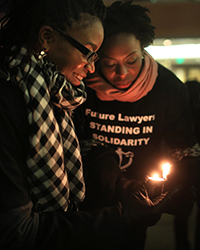
- The Access to Justice Institute (ATJI) is the home for pro bono, public interest, and social justice activities within the law school and offers opportunities to engage with underserved and marginalized communities and to use the law as a means to effect social change. ATJI hosts or sponsors many events through the year, including a Social Justice Mondays speaker series to encourage awareness and discussion.
- The Northwest Center for Indigenous Law develops advocates for indigenous peoples and tribal communities by delivering an array of educational programs, services, and opportunities for law students, tribes, indigenous peoples, and attorneys.
- The Center for Civil Rights and Critical Justice educates future lawyers to be agents for social change and racial equality in all areas of the law, advocates for advancement of the law to achieve equal justice, and produces research to drive effective reform by revealing systems of oppression and exclusion.
Contact
Kristin DiBiase
Associate Dean,
Student Life, Diversity & Inclusion
Sullivan Hall 200C
206-398-4307
kdibiase@seattleu.edu