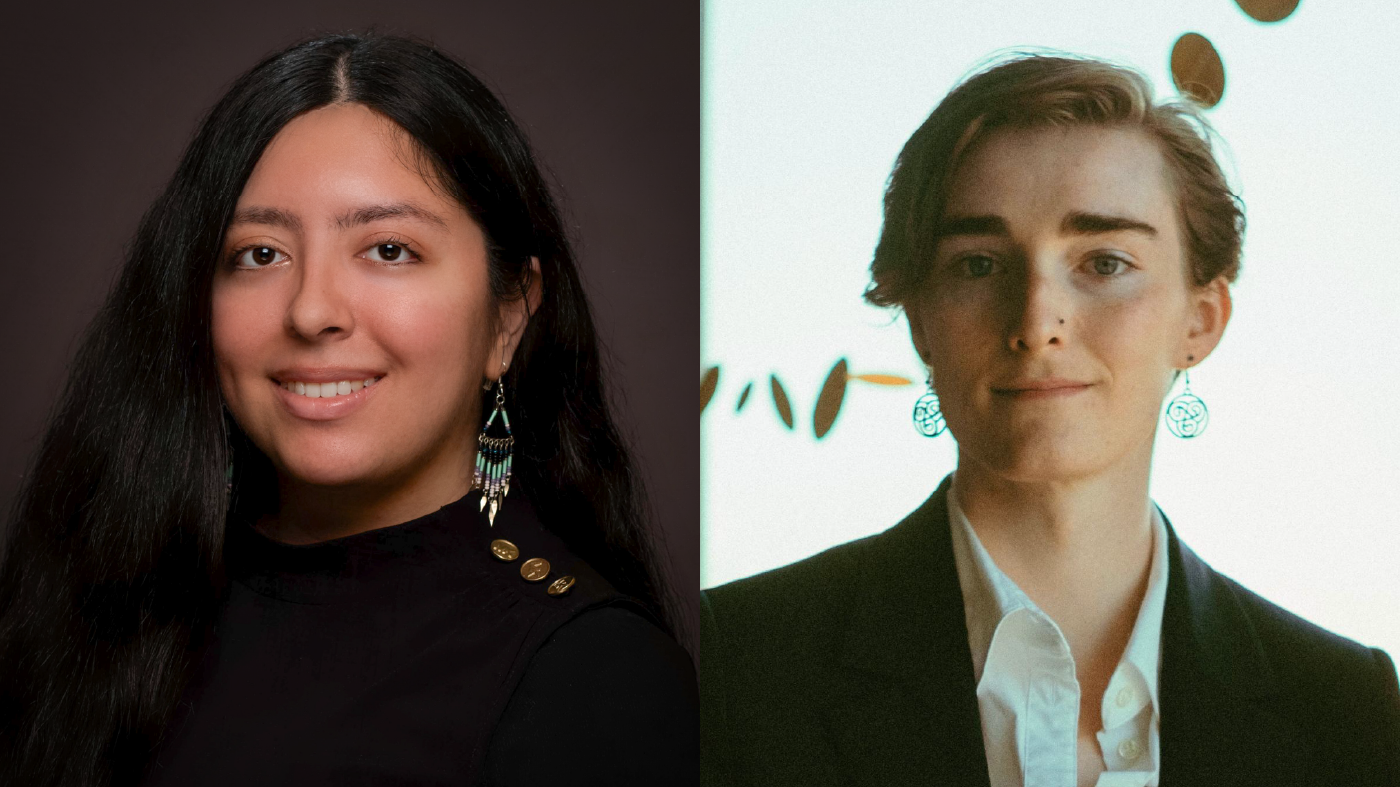
Two 2026 Seattle University School of Law graduates earned Equal Justice Works Fellowships to provide transformative legal services to survivors of gender-based violence.
Nohely Diaz ’26 and Jamie Eymann ’26 are two of just 60 legal scholars chosen for the fellowship across the country. Equal Justice Works (EJW) Fellows pursue a social justice project of their own design over the next two years.
Social justice put into action
Diaz is working with tribal communities to offer a variety of vital services to survivors of sexual and domestic violence.
“This project seeks to address gaps in legal services and existing resources by offering culturally responsive advocacy for survivors seeking legal assistance, specifically focusing on low-income, urban, and other multiply marginalized Native survivors throughout Washington,” she said. “The initiative prioritizes comprehensive legal care for the most vulnerable populations, aiming to meet their legal needs holistically while empowering survivors.”
She noted that Washington has recorded the second-highest number of missing and murdered Indigenous women and people (MMIWP) cases in the nation. There are 29 federally recognized tribes that live in Washington.
“This work matters as sexual violence is a prevalent issue, yet the road to justice is often difficult for survivors to navigate,” Diaz said. “That is why approaching this work with a culturally responsive and trauma-informed lens is crucial in ensuring individuals receive comprehensive legal representation.”
In partnership with Seattle U Law’s Northwest Center for Indigenous Law (NCIL), the project will be housed at the Sexual Violence Law Center, a Washington-based nonprofit law firm dedicated to providing integrated statewide legal support and advancing survivor justice, all through a racial and gender equity lens.
“Coming from an Indigenous background, Missing and Murdered Indigenous Women and People (MMIWP) was an area of concern that Indigenous communities spoke out about, long before the term MMIWP was first introduced. I knew of the personal loss in my family as a direct result of violence targeting girls,” Diaz said. “These lived experiences made me feel strongly about advocacy and action taking place not only when there is a tragedy in our communities, but also to serve as a preventative tool to further protect the lives of some of our most vulnerable and at-risk members.”
Eymann, too, is exercising their passion for aiding survivors of gender-based violence in the region.
“I am participating in a Design-Your-Own Fellowship project with multiple components,” Eymann said. “First, it aims to close an advocacy gap for youth impacted by gender-based violence in King County through direct legal representation tailored to and informed by their needs.”
The second component will be a phase of gathering information. Eymann will investigate the intersecting legal support needs of obtaining housing for youth who have survived gender-based violence, especially those in child welfare, homelessness, juvenile court, and immigration systems.
The third component aims to strengthen the community by conducting outreach with gender-based violence and shelter service partners to facilitate youth referral streamlining, feedback solicitation, and legal education for service providers and affected youth.
“Working with Legal Counsel for Youth and Children, the overarching goal is to develop a gender-based violence-focused direct legal representation model and expand legal capacity to serve housing-insecure youth who have suffered gender-based violence,” Eymann said.
The project is close to Eymann’s heart, lining up with their own work experience.
“Prior to law school, I worked in youth services, including foster care, education, and youth shelters,” Eymann said. “This project was developed with my former clients in mind, whose overwhelming legal, social, and economic needs often went unmet by systems not equipped to address them.”
What is public interest law?
Public interest law encompasses legal work intended to: secure justice for disadvantaged and underserved individuals or communities; assert, protect and defend human rights, civil rights and civil liberties; preserve and protect the world's health and resources for the benefit of the public good; or promote the public's interests protected by agencies of government.
Public interest lawyers work for nonprofits, legal aid organizations, government agencies, or other groups helping underserved communities obtain access to justice. This area of law is a major focus for Seattle U Law graduates, who engage in public interest work while still in law school through experiential learning, Public Interest Law Foundation grants, and the Pro Bono Pledge Program, among other ways.
About Equal Justice Works
Headquartered in Washington, D.C., EJW aims to break down the financial and structural barriers that prevent talented candidates from pursuing careers in the public interest sector. Throughout the project term, Fellows receive the support they need to focus on helping their communities, including competitive salaries, benefits, and loan repayment assistance.
Previous EJW two-year fellowship recipients from Seattle U Law include Katy Daley ’24, Mary Bent ’23, Charla Boley ’23, Gabi Nava ’21, Vallen Solomon ’20, Javiera Wood ’20, Alex Romero '19, Hyun-Mi Kim '19, Archie Roundtree, Jr. '18, Nick Allen '10, and Erin Shea McCann '07.