Prepare to work with Tribal Nations and Tribal legal systems through focused coursework and hands-on experience. The Indigenous Law Certificate builds students’ understanding of Tribal sovereignty, jurisdiction and contemporary legal issues while developing practical skills for ethical, culturally informed legal practice.
JD Program
Indigenous Law Certificate
Seattle University School of Law provides the opportunity to earn a Certificate in Indigenous Law.
The Certificate will require a mixture of courses, journal, and experiential learning resulting in completion of a minimum of 15 credits (an asterisk denotes availability to Flex JD students):
1. Required Courses (6 credits)
- Indigenous Peoples, Law, and the U.S. (3 credits or perhaps 4 credits in future)
- American Indian Tribal Law* (3 credits)
Complete Any Combination of at Least 9 Credits from the Approved Experiential Learning or Elective Courses Listed Below
2. Experiential Learning
- American Indian Law Journal (3-8 credits)*
- Tribal Law Clinic, International Human Rights Clinic, Regulatory Environmental Law Clinic, and the Civil Rights Clinic
- National Native American Law Student Association Moot Court Competition
- Center Research Fellowship or Independent Study/Substantial Paper (serving as a research assistant to the Center or an affiliated faculty member)*
- Indigenous Law focused Internship/Externship taken for credit and approved by Directors (e.g., Tribal Judicial Externship, Tribal In-House Counsel Externship, Civil Legal Aid Externship, and Tribal Criminal Justice Externship)*
3. Elective Courses
- INDL Courses
- Tribal Court Practice
- Social Impact Advocacy
- International Law of Human Rights
- Transitional Justice
- Natural Resources Law
- Climate Law & Policy
- Water Law
- International Environmental Law
- Lawyering for Social Change
- Environmental Law Fundamentals
- Environmental Justice
- Energy Law & Policy
- Family Law
- Immigration Law*
- Employment Law*
- Business Entities*
- Conflict of Laws
- Federal Courts
- Administrative Law*
- Intellectual Property
- International Intellectual Property
- Criminal Procedure*
- Trust & Estates*
- Negotiations*
- Complex Litigation
- Federal Litigation
- Sports Law
- Health Law
- Any Summer Flex JD Course not listed*
- JURS courses, including Courses from the non-clinic/externship, Law & Systemic Inequity Requirement course requirement such as Race & Law; Gender, Sexuality, & the Law; Law & Colonialism; Police & Prison Abolition; Abolition Vision and Praxis: Lawyering for a Freer World; Law & Social Science; Housing, Homelessness and Social Justice, etc.
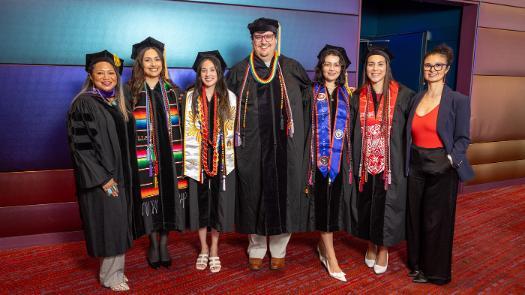
Congratulations to our first Indigenous Law Certificate graduates
Members of the inaugural Indigenous Law Certificate cohort celebrate their graduation at the May 2026 Commencement alongside Center Directors Nazune Menka and Brooke Pinkham.
The Indigenous Law Certificate was established to reflect our commitment to preparing lawyers who are equipped to engage with, support, and advance Tribal legal systems. The certificate’s core requirements are Indigenous Peoples, Law, and the United States and Tribal Law and students are also required to commit to meaningful experiential learning opportunities, emphasizing practical skills, cultural competency, and ethical collaboration with Tribal nations. The certificate fosters a deeper understanding of sovereignty, jurisdiction, and the unique legal and policy issues facing Tribal nations today.
Contact us
Northwest Center for Indigenous Law
Sullivan Hall 313
901 12th Avenue
P.O. Box 222000
Seattle, WA 98122
206-398-4084
NCIL@seattleu.edu