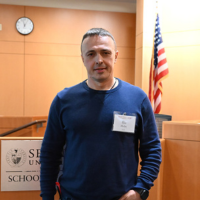
Two years ago, Artem Andreiev came to the U.S. not speaking a word of English.
He, his parents, and his sister fled Ukraine because their home city of Kremenchuk, a center of industry in Central Ukraine, was the frequent target of Russian bombs. They were grateful to be able to join other relatives in the Seattle area, but Andreiev had to start over in his career.
In Ukraine, Andreiev had earned bachelor's and master's degrees in law (the Ukrainian equivalent of a JD) before working at a district court and later a postal service company.
After a year in the U.S., Andreiev began working as a paralegal at SeaTac immigration firm Domingos Law Firm, where he uses his language skills and his own immigration experience to help other Ukrainian refugees find a new home. Andreiev's Domingos colleagues recommended that he study at Seattle U Law to become an immigration lawyer.
"It's the way I can help a lot of Ukrainians coming here. [Because of the new administration], people are losing their immigration status, but they want to be here because it’s still unsafe in Ukraine,” he said. “We try to support people in dangerous positions. It’s my goal to help people.”
So far, he appreciates the support of his professors at Seattle U Law and the helpful information he gained during Orientation Week.
“America was my childhood dream, but I never took it seriously, because it felt difficult to come here,” Andreiev said. Now in the U.S., he said, “How good is this country, how people-friendly, how many opportunities there are. If you’re hardworking and honest, it will give you a lot.”

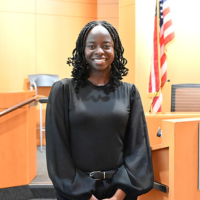
The Technology, Innovation Law, and Ethics (TILE) Institute and Technology, Innovation, and Entrepreneurship LLM drew aspiring technology lawyer Mallan Hope Apondi from Kenya’s capital of Nairobi across the globe to Seattle. During her undergraduate studies in law at the University of Nairobi, artificial intelligence came onto the scene, causing Apondi to develop a fascination in the intersection of law and technology.
“AI is a new field and there are not many regulations; the law is playing catch-up with it,” Apondi said. “It is fast evolving — what we had last year isn’t what we have this year, and next year it will change again. I want to be one of the leading lawyers ahead of the curve in relation to AI, to be part of the team considered experts in this field.”
In particular, Apondi would like to see mechanisms put in place to protect people’s data when information is fed to AI.
Apondi was excited to find Seattle U Law’s program that aligned perfectly with her interests, especially with its emphasis on AI. She is also thrilled to be in a city that is home to so many global tech players. Apondi looks forward to taking part in TILE activities and events, as well as the Privacy Law Student Association and AI Law Society.
“People at Seattle U Law are extremely helpful and kind, I can pop into an office without an appointment and they’re willing to help,” Apondi said. “Faculty and staff go the extra mile to help me out.”
After graduation, Apondi hopes to obtain a position as a technology lawyer specializing in privacy, cybersecurity, and AI.

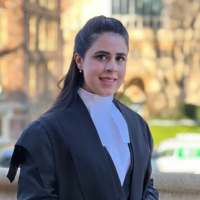
This is not Aiema Asrar’s first time studying outside of her home country of Pakistan. She obtained her bachelor’s degree in law from Royal Holloway, University of London, and took her Bar Profession Course in the British capital. There, Asrar trained as a litigation lawyer, becoming a member of Lincoln’s Inn (one of four Inns of Court in London).
Upon returning to Pakistan, Asrar worked her way up to a senior associate (just one step below partner), advising the Pakistani government on its space policy.
“I started getting interested in tech and how that interacts with the law,” she said. “I realized while advising the government that not many lawyers are familiar with the tech side, and that has really impacted the laws that have developed over time.”
Asrar sought out Seattle U Law for its LLM in Technology, Innovation, and Entrepreneurship. She enthusiastically described her first few Digital Commerce lectures with Distinguished Practitioner in Residence Steve Tapia, which were not about law at all, but rather explained how computers work and the basics of coding, so that future tech lawyers could know more about the subjects they will be litigating.
“Where you’re studying really impacts your curriculum,” Asrar said. “Being in a tech hub like Seattle, I realized the exposure I’m getting in class is something I’m getting so much more than anywhere else.”
Asrar does intend to take the bar, to add a third country to the list of nations where she is qualified to practice law, but she plans to return to her firm in Pakistan and continue advising the government, this time on its artificial intelligence policy.
In the meantime, she plans to join the Womxn’s Law Caucus and the Technology, Media, and Telecommunications Law Association, as well as enjoy walks around the beautiful university campus.

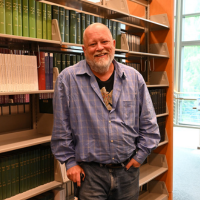
Chris Chapman is a unique internationally educated LLM student in that he was born and raised in the U.S. Originally from Portland, Oregon, Chapman completed his undergraduate studies and MBA in the U.S. before moving to his Australian wife’s home country in 2000.
Seattle U Law isn’t Chapman’s first Jesuit law school. He obtained his JD from the University of Notre Dame, in the suburbs of Perth, on Australia’s West Coast. At the time, he was one of only four students to have graduated with a JD from the school, as the usual law degree for Australians is an LLB.
“Having gone to Notre Dame I was very comfortable with the Jesuit mission when I arrived at Seattle U Law,” Chapman said. “The ethics appealed to me.”
Chapman worked in litigation at both corporate and at small firms in Sydney and Melbourne before eventually moving back to Seattle with his Australian cat, Percy.
“I had the harbor view office in Sydney, I’ve lived in that world,” Chapman said. “It was nice, but now I’m looking to do public interest.”
The November 2024 election spurred Chapman to go back to school and become a lawyer on this side of the Pacific. Now at Seattle U Law, Chapman is already busy — he signed up to volunteer with the Youth Traffic Court, has a schedule full of advocacy-related classes and is hoping to take part in a clinic next semester.
“When the election results and outcomes were clear, I thought, ‘I have to do something, it’s time to do what I can,’” Chapman said. “I would like to end up where I can do the most good.”

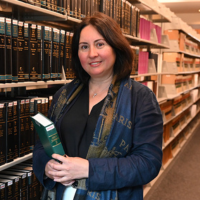
Oksana Davletshina’s passion for justice has taken her across a variety of countries and states to serve others.
She earned a Ph.D. in law and worked as a family and corporate lawyer for more than 25 years in her hometown of Rostov-on-Don, Russia, before moving to Portland, Oregon, with her family in 2016. Having studied domestic violence law, Davletshina used her legal and language expertise as a sexual assault and domestic violence advocate to help members of Slavic communities through Portland nonprofits. She noted that many immigrants choose to stay in abusive relationships due to immigration law issues and language barriers.
“Family law is not just a legal practice for me — it is a space where compassion meets diligence, and where the opportunity to create meaningful, positive change in people’s lives is paramount,” Davletshina said.
She worked closely with attorneys on cases involving child custody, divorce, and domestic violence. Through her efforts, she witnessed firsthand the transformative impact of compassionate legal assistance, but she realized that she could do even more with a law degree. Seattle U Law’s social justice values were so appealing to Davletshina that she moved to Seattle from Portland to attend.
“I like the mission of this university,” Davletshina said. “I will always fight for justice no matter what.”
She loves her Family Law course and plans to volunteer with the Family Law Center.
“Seattle U Law gave me the opportunity to fulfill my dreams and renewed my hope for the future,” Davletshina said. “My long-term goal is to work with immigrant communities and survivors of domestic violence, offering the legal support and advocacy they need to rebuild their lives.”

From the time Illia Hulin was a child, he dreamed of becoming a lawyer. He earned a bachelor’s degree in law in 1999, going on to run his own law firm and real estate agency for 15 years.
Three years ago, when Russia invaded Ukraine, Hulin, his wife, and his now 8-year-old daughter fled to the U.S. Living in Alchevsk, situated in between Donetsk and Luhansk in Eastern Ukraine, they had been in the middle of the worst of the danger.
The Hulin family settled in Federal Way, where they had friends from Ukraine. Since then, Hulin has worked as a real estate broker in Issaquah and part-time at the Tacoma Slavic Association (TSA), where he assists other refugees in completing their immigration documents. His director at TSA recommended Seattle U Law.
“I did the research about the university and believe it’s a really good school for me,” he said. “It’s really strong academically. I love it so far.”
He especially enjoys Constitutional Law and Family Law. Once he has his degree in hand, Hulin would like to start his own firm. While he would like to practice family law and real estate again, his biggest priority is immigration law.
“I am an immigrant, and all of my friends are immigrants,” he said. “I have to help them.”

Navdeep Kaur initially began studying medicine, but her lifelong fascination in politics led her to switch to law. While completing her bachelor’s in law, she interned with a criminal lawyer at the district court in her home region of Punjab, India, before working as an associate there after graduation. However, Kaur’s passion for the political world led her to further her education abroad.
“I had a deep interest in politics since day one,” she said. “I was always looking for countries where I can learn things that I can implement back home.”
Her first foray into Seattle University began in fall 2024, when she started in the Masters in Public Administration (MPA) Program. However, she switched this year to the LLM Program at Seattle U Law.
“I always wanted to practice law in the U.S.,” Kaur said. “I want to gain experience on a global level, how the system works, the global trends.”
Kaur loves her classes and the helpfulness of her professors so far. She is also active in student life as the treasurer of the Punjabi Law Society. After graduation and taking the bar, she would like to finish her MPA and work as a lawyer in the U.S. for a few years. Eventually, she plans to return to India and work in politics, with the goal of helping to bring about reforms in education, criminal law, and health care.
“I want to make a real change back home in my country,” Kaur said.

For the past several years, Cuban lawyer Jose Reyes Moreno has worked at bars in Florida and Ohio, but now he will trade bartending for the bar exam.
Moreno moved the 200 miles from Cuba to Miami in 2019 because he wanted to live “the American dream.”
“I wanted to develop my life, my career, to develop my skills as a lawyer and a person, and the U.S. is the best place,” Moreno said. “It’s a big country with a lot of opportunities.”
After earning a bachelor’s in law at the University of Havana, Moreno practiced law as a notary public, a role that in Cuba requires a law degree and a special exam. Working in family law and real estate law, he drafted contracts, wills, power of attorney documents, and more.
Now, he sought out Seattle U Law for its international programs, as well as for Seattle’s natural beauty and status as a global city with many cultures. He has joined the Latinx Law Student Association and hopes to volunteer with immigration clinics.
“Sometimes law school is very competitive, but here, people are very nice,” Moreno said. “They’re very accepting, not xenophobic. There’s integrity here.”
Having gone through the process of coming to this country, he plans to become an immigration lawyer.
“The most important thing is to defend my community. Right now, a lot of people need help,” he said. “When you’re an immigrant here, you need to use your knowledge and experience in that kind of law. People feel like you’re on the same page, they trust you, they have confidence.”

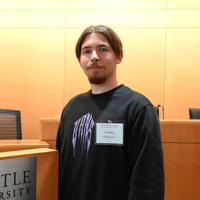
After receiving her bachelor’s in law at Azad University in her home city of Tehran, Iran, Sanaz Nikooparast passed Iran’s version of the bar and worked for more than a year in a family law firm. This work suited her, as she has a passion for aiding mothers and children in difficult situations.
Ten years ago, Nikooparast moved to the U.S. to join her mother, who is an American. She spent time working in Arizona before moving to Seattle to be closer to relatives in Vancouver, B.C.
Nikooparast considered going back to school for a biology degree, but she knew that the law was her true calling. She was happy to find that with an LLM degree from Seattle U Law, she will be able to sit for the bar in Washington.
“I love Seattle U Law because I want to continue my education and I want to be a lawyer as I was,” she said. “It is a good opportunity for me.”
So far, her favorite courses are Legal Writing, Civil Procedure, and Torts. Nikooparast is considering joining the Middle Eastern and South Asian Law Student Association (MESALA) and finding an externship or an opportunity for pro bono work in the family law area next semester.
“I love to help vulnerable people, like women and children,” Nikooparast said.
Nikooparast would like to return to family law permanently after graduation, although she is also looking at property law. No matter what, she plans to devote some of her time to providing pro bono aid in the family law sector, because, as she noted, many women stay in abusive situations due to a lack of funds.

Chimwemwe Nyimba, who goes by Chimz for short, was reminded of his native Malawi when he arrived in Seattle’s late-summer heatwave at the end of August.
Nyimba earned a bachelor’s in law in Malawi and a master’s in tax law in South Africa, before becoming a partner at Sankara and Associates, a tax advisory firm in Malawi’s capital, Lilongwe. During his studies, he focused on international tax systems, including that of the U.S., which he finds fascinating because “tax law is the intersection of all branches of law.”
“I definitely want to get hands-on experience here in taxation and lobbying,” Nyimba said. “Lobbying is not done in Malawi the way it is done here, where people work full-time to change tax policy through lobbying.”
Nyimba chose Seattle, the home of some of the world’s most prominent tech companies, because he hopes to get tax-related work in the tech sector. As a part time pastor, he was also drawn to Seattle U Law’s Jesuit values.
“I love it here, it’s pretty exciting,” he said. “The law school is very interested in the welfare of the students, especially international students. It’s quite welcoming and quite warm.”
While at Seattle U Law, Nyimba hopes to participate in Moot Court and the Property and Tax Law Society, as well as campus ministry. He is also considering enrolling in the SJD Program next year. But what he is most looking forward to is his wife, a public health practitioner, and three children — two girls and a boy, all between 3 and 10 years old — joining him in November, when they will all make Seattle their home.

Maria Rountree-Olivares is a triple threat. While earning a law degree as a full-time student, she finds time to run her two businesses, the Lemon Grove clothing shop in Pioneer Square and MRO Consulting, which advises construction companies on matters such as compliance and employment law.
“When you own a business you work 24/7, but when it means so much to you, it’s worth it,” she said.
Hard work is in Rountree-Olivares’ nature. While a law student at the University of Cartagena in her native Colombia, she worked for a law firm and for one of her employment law professors, and after graduation, she continued her employment law work at the Court of Appeals as a judicial clerk. While on a trip to visit relatives in Seattle, she fell in love with the city, and moved here four years ago.
Rountree-Olivares’ consulting firm caters to Latino-owned and operated construction businesses, where she can help those who immigrated to a new home and learned a new language just as she did.
“The feeling of being an immigrant calls for building a community. How you create the feeling of belonging is engaging in the community, giving back to community,” she said. “I found a niche that my community needed these services, my passion guided me to that. I found a sense of family here.”
With an American law degree, she would like to expand her employment law work at her business. In the meantime, she plans to volunteer with immigrants through the Access to Justice Institute and the Seattle Office of Immigrants and Refugee Affairs Immigration Clinics.
“Having open expression about what guides me is important, feeling comfortable like I belong here, seeing people like me in positions of leadership here,” she said. “Having people not just say you can do it but showing you how to do it and guiding you, that matters. I found that at Seattle U Law.”

Ukrainian law graduate Tina Vasylenko has already helped to pass laws for the European Union. While obtaining a master’s degree in law in Brussels, she was awarded a Blue Book traineeship with the European Commission, the primary executive branch of the EU, where she worked on the modification and adoption of the Corporate Sustainability Due Diligence Directive. Adopted by the European Commission and Parliament Council, the directive aims to ensure that large companies “identify and address adverse human rights and environmental impacts of their actions.”
“Ukraine would love to join the European Union, so it was really interesting for me to get involved in that process,” said Vasylenko, who speaks Ukrainian, Russian, French, Spanish, and Mandarin. “My time working abroad enriched my experience. I met so many people from diverse populations and learned foreign languages. I feel blessed.”
Vasylenko worked in the advocacy department of ExxonMobil in Belgium and in Shanghai before joining her cousin in Vancouver, Washington, after the war in their home country began. As a bilingual interpreter and family liaison for the Vancouver School District, she used her own language skills and immigration skills to work with the region’s large Slavic population.
She chose Seattle U Law because she found the courses and programs to be very practical for foreign lawyers, and because she spoke to current LLM students who were pleased with the program. After graduation, she plans to work for a nonprofit or non-governmental organization (NGO), either in the U.S. or Europe.
“I will be happy to help people of all nationalities and backgrounds achieve justice,” she said.

Chunchchao (Cici) Zhang began her legal career in management training for a public trading company in Hong Kong. With a bachelor’s in international trade law from Dalian Maritime University and master’s in common law from the University of Hong Kong, she mapped out a career for herself as a corporate trade lawyer.
However, fate intervened 10 years ago when her husband got a job at Microsoft and the family relocated to Seattle. Unable to practice law in her new country, Zhang earned a bachelor’s in computer science at the University of Washington, but she still felt her heart pulled to the legal field.
“I thought I would never do law school because of my age — it feels 10 years too late — but I found this program at Seattle U Law and learned that an LLM can qualify you to take the bar in Washington, so I feel that it’s a perfect time and opportunity,” Zhang said.
She appreciates the small, tightly-knit environment of Seattle U Law, including the way that staff and faculty have reached out to her with guidance.
“I chose Seattle U Law because the environment here is friendlier and teaches you more about the practical approach, how to actually be a lawyer,” she said. “Our goal is not just academic research, it’s to practice.”
While earning her degree, Zhang is continuing her full-time job as a corporate paralegal. She hopes to pass the bar in both Washington and New York, as her company offers opportunities in both of those states.