It is often said that we live in a “knowledge economy” in which knowledge has value and access to knowledge is essential to inclusion.
Yet recent attacks, such as draconian funding and personnel cuts to important cultural institutions such as museums and libraries, bring into question the fundamental but often under-appreciated roles these institutions play in advancing, maintaining, and preserving the public’s access to and trust in reliable knowledge that powerfully undergirds robust democracies and societies.
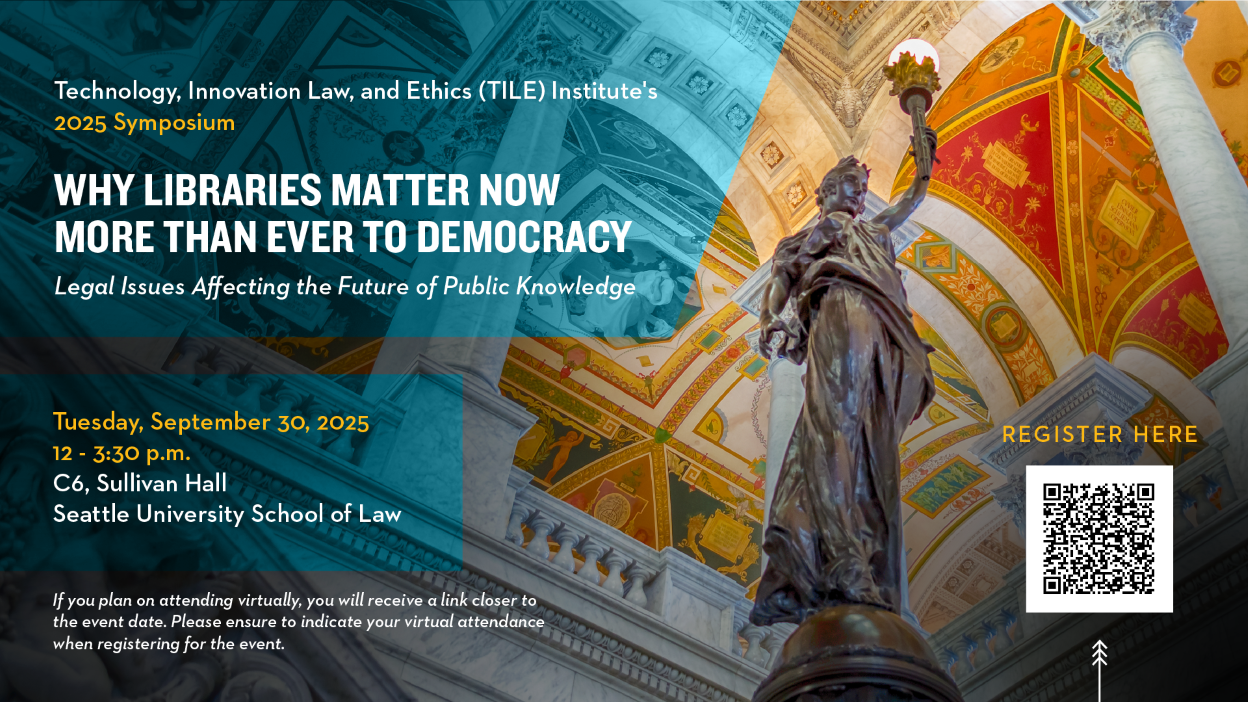
The TILE Institute’s 2025 Symposium is on the theme of “Why Libraries Matter Now More than Ever to Democracy: Legal Issues Affecting the Future of Public Knowledge.”
This timely symposium brings together experts in copyright law, technology, and libraries to discuss key legal issues and propose sustainable future directions to steward public knowledge that is one of the key pillars of a functioning democracy.
The symposium will take place on Tuesday, September 30th in Room C-6 of Sullivan Hall at the Seattle University School of Law from noon to 3:30 p.m.
Background and Resources for Attendees
Journal of the Copyright Society, volume 72(3): Special Library Issue
Co-sponsored by the Seattle University Law Review and the Seattle Journal of Technology, Environmental & Innovation Law.
Noon
Welcome from Dean Tony Varona and Professor Maggie Chon
12:15 – 1:45 p.m.
Panel One: THE MULTIPLE ROLES OF THE LIBRARY OF CONGRESS IN PROTECTING DEMOCRACY
Moderator: LeighAnne Thompson, Associate Director of Digital Innovation, Seattle University School of Law Library
Hope O’Keeffe and Nancy Weiss
“Why the Library of Congress Matters”
Access the presentation slides here: Why the Library of Congress Still Matters
Amanda Runyon and Leslie Street
“The Library of Congress Under Fire: Can Congress Create a New Legal Framework to Protect its Mission?”
Blake Reid
“AI Politics and the Future of the U.S. Copyright Office”
1:45-2:00 p.m. Break
2:00-3:15 p.m. Panel Two: HOW LIBRARIES CAN LEVERAGE TECHNOLOGY TO EXPAND ACCESS TO PUBLIC KNOWLEDGE
Moderator: Professor Margaret Chon, Faculty Director, TILE Institute
Aaron Perzanowski
“The Licensed Library”
Michelle Wu
“Leveraging Technology and Copyright to Revolutionize Libraries in the Service of the Public Interest”
Dave Hansen
“Keeper of the Commons: The Library of Congress and Its Unique Copyright Role”

“Keeper of the Commons: The Library of Congress and Its Unique Copyright Role”
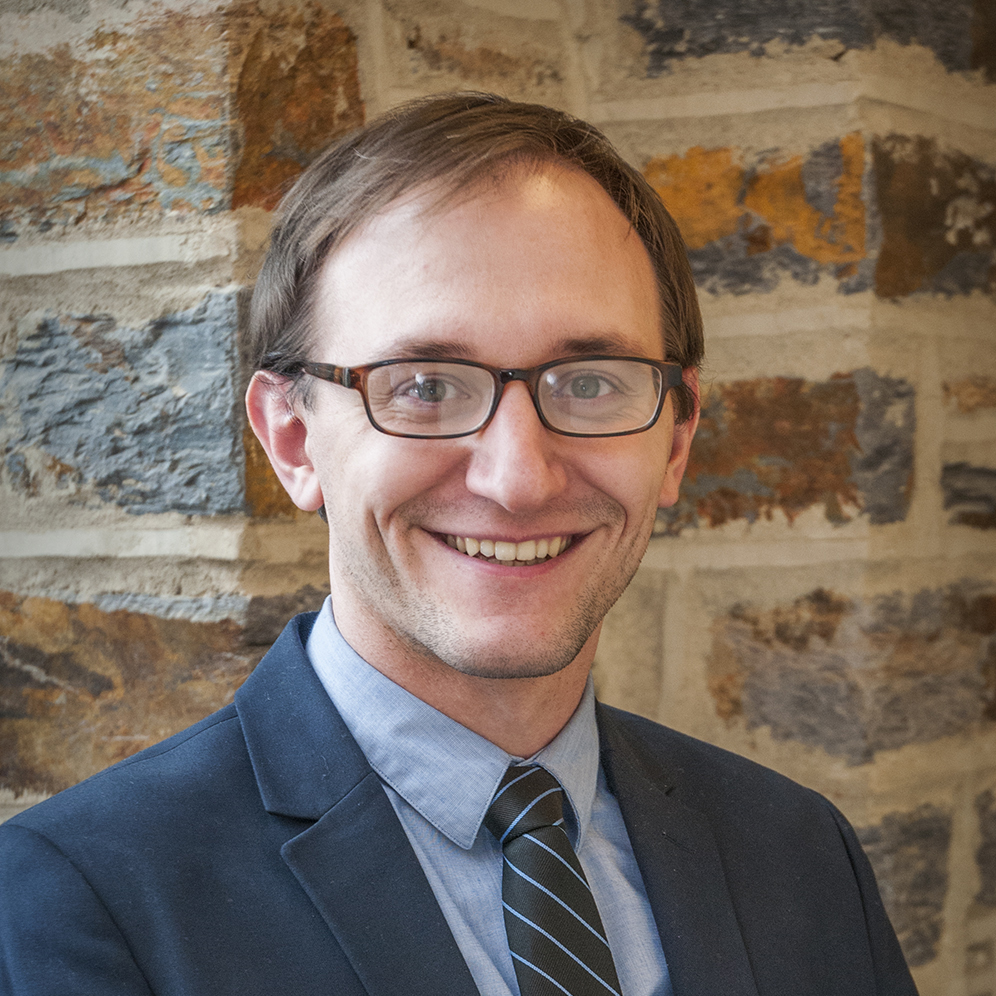
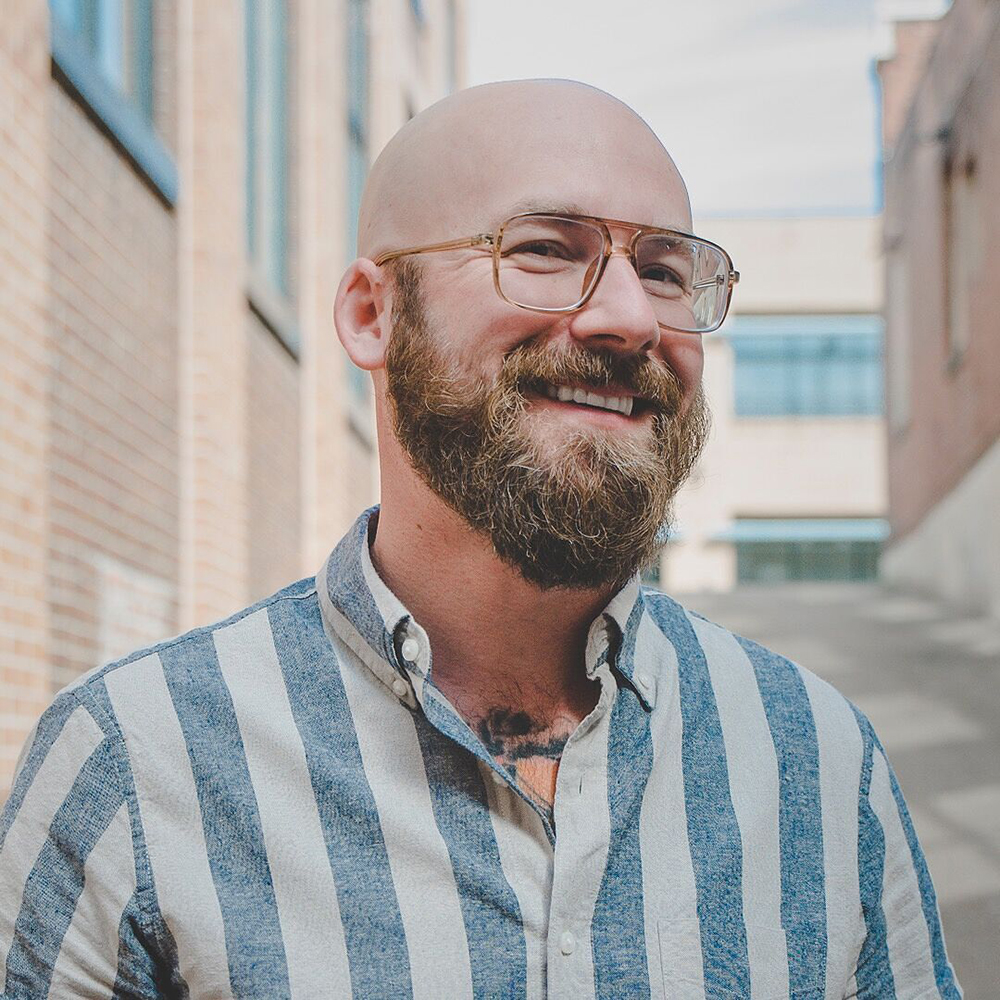
David Hansenis the Executive Director of Authors Alliance, a nonprofit that aims to support authors who want to see their works widely distributed for the benefit of the public. Authors Alliance has led efforts to secure copyright exemptions for text data mining researchers and has played an important role in advocating for legal access to research corpora for computational research.
Dave has testified before Congress, the U.S. Copyright Office, and the USPTO on copyright, AI, open access, and fair use issues affecting academic authors and universities. He has also advocated for researchers' rights under copyright and the First Amendment in numerous federal cases. Before Authors Alliance, Dave was Lead for Copyright & Information Policy and an Associate University Librarian at Duke University. He holds a JD and MSLS from UNC Chapel Hill and previously held academic appointments at UC Berkeley School of Law and UNC Chapel Hill School of Law.

“Why the Library of Congress Matters”
Hope O’Keeffe was Senior Associate General Counsel of the Library of Congress from 2006 until 2024, managing legal matters involving collections, acquisition, and access, including copyright, social media, digitization, events, and exhibits. Prior to that she worked at the National Endowment for the Arts. She attended George Washington University Law School and Amherst College and clerked for Chief Judge Spottswood W. Robinson of the DC Circuit. Since retirement she has been doing pro bono digital access work for the Flickr Foundation and fomenting good trouble.

“The Licensed Library”
Aaron Perzanowski is the inaugural Thomas W. Lacchia Professor of Law at the University of Michigan Law School. He teaches and writes about the intersection of intellectual and personal property law. Much of his work explores the notion of ownership in the digital economy. His books include The End of Ownership, co-authored with Jason Schultz (MIT Press, 2016), and The Right to Repair (Cambridge University Press, 2022). His current book project addresses how shifting conceptions of ownership threaten to undermine the core functions of libraries.

“AI Politics and the Future of the U.S. Copyright Office”
Blake E. Reid researches and writes on law, policy, and technology, with a focus on telecommunications, internet, copyright, and disability law. He i s an Associate Professor of Law at Colorado Law, where he serves as the Faculty Director of the Telecom and Platforms Initiative at the Silicon Flatirons Center and served as the director of the Samuelson-Glushko Technology Law & Policy Clinic from 2013 until joining the research faculty in 2023. His work has or will be published in the Stanford Law Review, California Law Review, Indiana Law Journal, and the U.C. Davis Law Review. In 2023, he joined the author team for Communications Law and Policy: Cases and Materials, an open-access telecommunications law casebook, with Jerry Kang and Alan Butler.

“The Library of Congress Under Fire: Can Congress Create a New Legal Framework to Protect its Mission?”
Amanda Runyon is Associate Dean and Director of the Biddle Law Library at the University of Pennsylvania Carey Law School, where she also serves as a Lecturer in Law. She teaches advanced legal research courses at the law school and teaches Leadership and Management in Law Libraries at the University of Washington Information School. Her research explores the role of information in preserving democracy, improving the accuracy of citation metrics in legal scholarship, assessment in law libraries, and empirical studies of law library collections. Prior to joining Penn Carey Law, she held leadership roles at the University of Michigan and the University of Texas law libraries and began her legal career in the Ohio Department of Job & Family Services.

“The Library of Congress Under Fire: Can Congress Create a New Legal Framework to Protect its Mission?”
Leslie Street serves as the Director of the Wolf Law Library and as Clinical Professor of Legal Research at William & Mary Law School. She graduated from Brigham Young University’s School of Law cum laude and earned her BA from BYU, magna cum laude . Additionally, she received a master’s degree in Library and Information Science (MLIS) from the University of Washington. After law school, Professor Street practiced as an Assistant Corporation Counsel for the City of New York, working in the Bronx Family Court Division. She then worked in private practice at a firm in Tacoma, Washington for two years, focused on family law and immigration. While in Washington, Professor Street worked extensively for the Southern Sudanese Community of Washington. Professor Street's research interests are varied, but primarily focused on legal information policy and the intersection of technology and the structure of legal information. She also speaks and researches on the issues of copyright and libraries. Professor Street is active in regional, national, and international law library organizations. She is the past chair of the Government Relations Committee of the American Association of Law Libraries and currently serves in the International Federation of Library Associations and Institutions (IFLA) as an elected member of the Professional Council and as an appointed member of the Copyright and other Legal Matters Advisory Committee.

“Why the Library of Congress Matters”
Nancy Weiss served as the first General Counsel of the Institute of Museum and Library Services (IMLS) the primary source of Federal support for the U.S.’s more than 140,000 libraries and museums, Senior Advisor for IP and Innovation at the White House, and the Fifth Kaminstein Scholar in Residence and Senior Advisor to the Register of Copyrights at the Library of Congress. Other government positions have included Secretary of the White House-appointed National Museum and Library Services Board, Executive Committee Member and legal counsel for the International Arts and Artifacts Indemnity Program, and National Endowment for the Humanities designee to the three-person National Archives and Records Administration Trust Fund Board. Nancy has represented the U.S. government at the United Nations and other international bodies, and been a key drafter of groundbreaking international treaties, including the Marrakesh Treaty to Facilitate Access to Published Works for Persons with Print Disabilities; the Washington Conference Principles on Nazi-Confiscated Art to address outstanding issues from the Holocaust Era; United Nations Educational, Scientific, and Cultural Organization conventions; and United Nations; priorities and work-plans for digital governance and inclusion. Nancy graduated with honors from the University of Michigan Law School, clerked for the Hon. William Schwarzer (N.D. Cal; Federal Judicial Center), and practiced law at Williams & Connolly, one of the nation’s leading litigation firms.

“Leveraging Technology and Copyright to Revolutionize Libraries in the Service of the Public Interest”
Michelle M. Wu is a retired law library director, associate dean, and professor of law. She has over 25 years of experience in law schools and libraries, including as Law Library Director, Associate Dean, and Professor at Georgetown Law and Hofstra Law, an Acting Director at the University of Houston Law Center, and as Assistant Director for Information Services at The George Washington University School of Law. She is an inductee to the AALL Hall of Fame, has taught Copyright and Copyright Licensing, and writes regularly on copyright, libraries, information management, and leadership.
Margaret Chon
TILE Faculty Director and Professor of Law
mchon@seattleu.edu