- What is the Scholars for Justice scholarship?
- Meet Maryellen Burfeind, 2026 Scholar for Justice
- Meet Nina Daro, 2026 Scholar for Justice
- Celebrate 20 years of Scholars for Justice
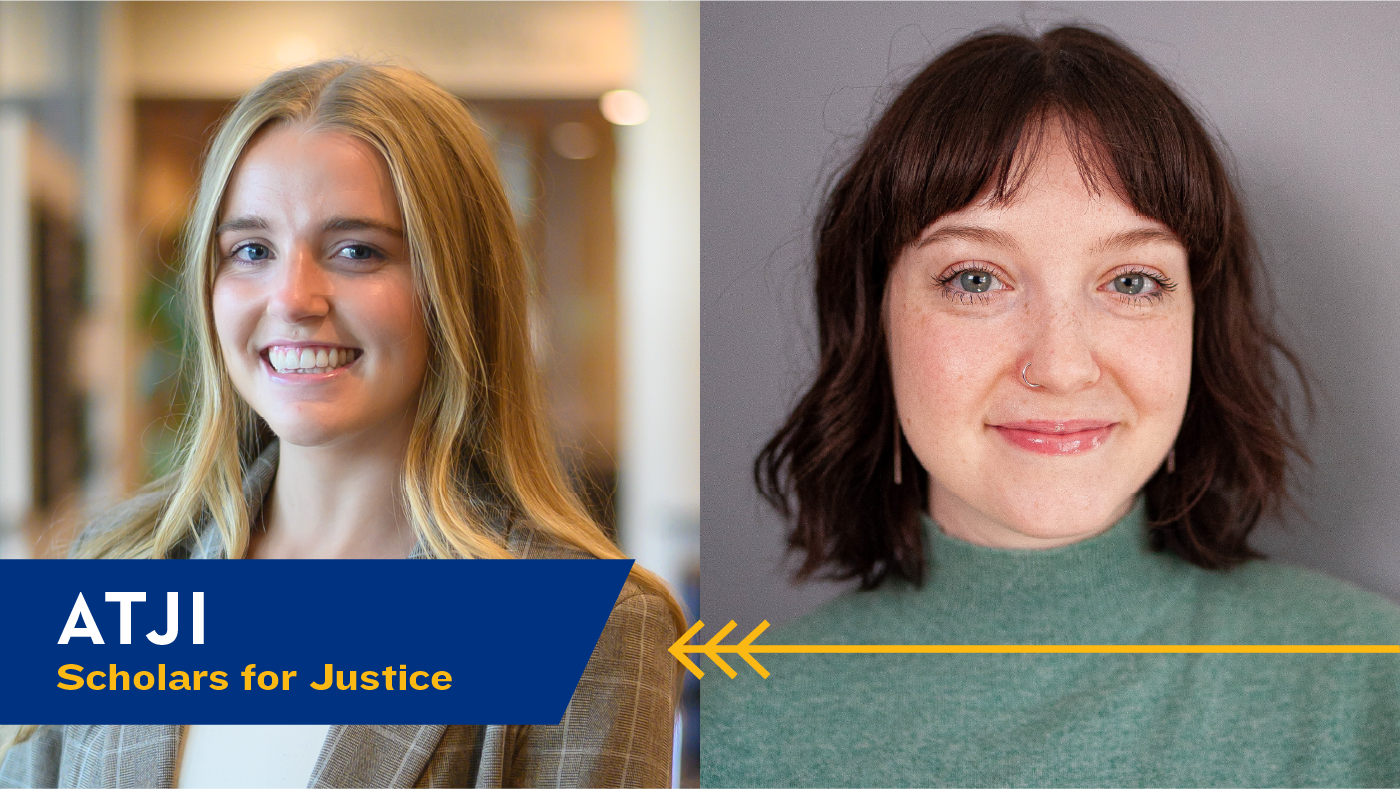
Whether through advocating for workers, children, or those seeking clemency, this year’s Scholars for Justice aim to use their legal careers to give a voice to others.
With public interest work in the Seattle area already under their belts, the scholars already made a difference in the local community before even sitting down for their first day of law school.
What is the Scholars for Justice scholarship?
Each school year, the Seattle University School of Law Access to Justice Institute (ATJI) provides full-tuition scholarships to two incoming JD students who demonstrate commitments to community service, academic excellence, and a future in public interest law. This year marks the 20th year that Seattle U Law has selected Scholars for Justice.
Scholars for Justice must take the Pro Bono Pledge to complete at least 100 hours of pro bono work before graduation. Additionally, they must maintain at least a 3.0 GPA, seek out volunteer and leadership opportunities, and commit to working in the public interest area of law for at least one year within three years of graduation.
Maryellen Burfeind
Maryellen Burfeind always knew while growing up in Bellingham, WA, that she wanted to work in public service in some capacity one day. It was during her studies of law, societies, and justice at the University of Washington when she volunteered with the Seattle Clemency Project that advocacy through the law caught her eye.
Burfeind and her colleagues aided attorneys in a pro bono petition for clemency for a man who had been sentenced to life without parole decades before as a young adult (which the state later outlawed). The team told the petitioner’s story, in particular his reflection on and regret for his past actions, and his commitment to turn his life around.
“Getting to sit next to someone like that and be a sounding board, to use our voice to tell his story, and to reframe that in a legal advocacy way is pretty cool,” she said.
She continued her volunteer work with the petitioner after graduation as she worked in child care, a field that saw her using many of the skills she uses in law, such as communication, empathy, and learning. She would love to be able to combine these two areas one day, perhaps by advocating for children.
When it came time to choose a law school, the decision was not hard. Through her work at the Seattle Clemency Project, Burfeind got to know graduates of Seattle U Law and became familiar with the school’s social justice focus and lifechanging work in the community.
“I’ve been in Seattle for the past six years - you’re always hearing about work that Seattle U Law is doing,” she said. “Choosing Seattle U goes hand-in-hand with community immersion – the commitment to public interest.”
It was a decision that has made Burfeind happy. In addition to taking part in the Womxn’s Law Caucus and ATJI’s Social Justice Mondays, she is exploring future experiential learning opportunities through Public Interest Law Foundation (PILF) grants and Legal Counsel for Youth and Children (LCYC).
“Other students [at Seattle U Law] want you to succeed, which can be rare at law schools. All of that solidified the cultural and community impact and the value of community,” Burfeind said. “When you’re doing advocacy work, it’s important to work as a team. You’re relying on people to mentor you and get ideas from them. I wanted that to be reflected in my legal education.”
She is grateful to Scholars for Justice for setting her up on a track of public interest-focused work. Ideally, she hopes to return to her hometown of Bellingham and work in the public interest arena.
“I want to work with people, to be able to do research, and to help them use legal literacy as a tool,” she said. “I realized that there is such a disparity of legal literacy and how life-changing it can be when you have legal literacy.”
Nina Daro
Nina Daro’s passion for labor rights drew her to study law. While a student at Brooklyn College in New York, she worked with unionizing efforts on campus during a fellowship.
“That opened up my world, and I really wanted to work in the labor movement,” said Daro, who is originally from Oklahoma.
After a research-heavy internship with the Writers Guild of America East, she set her sights on labor research. Daro landed an internship at the national American Federation of Labor and Congress of Industrial Organizations (AFL-CIO) and was offered a fellowship to learn strategic corporate research and labor research, focusing on a multi-union organizing project in Seattle at MLK Labor (where she was later hired).
“Research is useful with organizing new unions and bargaining to reach an agreement,” Daro explained. “An organizer’s role is to understand the workers’ issues from their perspective, and a researcher’s role is to understand the company’s role from their perspective.”
The project brought together national unions wanting to invest more in local organizing efforts, including those of workers at Seattle stadiums and Seattle-Tacoma International Airport, as well as gig worker cooperatives that launched during the 2026 FIFA World Cup. Through negotiations with Lumen Field ahead of the World Cup, Daro worked closely with union lawyers and saw firsthand how important it is to know the laws backwards and forwards when creating labor agreements.
“I thought, ‘That’s kind of the role that I would like to be in,’” she recalled, and resolved to become a lawyer.
“Organizing is really hard in the U.S. with our labor laws, so you have to be smart about it,” she said. “It’s a major onus on the workers to navigate so much union-busting. So much of it is also legal. It’s thinking about how to rise above the current on-paper laws.”
Wanting to stay in the city where she discovered her love of law, Daro was drawn to Seattle U Law because of its social justice focus and deep connections to the local labor movement. She enjoys the “cozy, tucked away, gorgeous” campus and the supportive, non-competitive attitude of the student body.
Daro is using her time at law school to explore many areas of law that intersect with workers’ rights, including immigration, and is interested in being involved with student groups such as the Justice in Employment and Labor Law Organization (JELLO) and the Seattle U Law chapters of the National Lawyers’ Guild (NLG) and the International Refugee Assistance Project (IRAP).
Ultimately, Daro’s goal is to learn the law so that she can better empower workers to advocate for their needs.
“It’s really cool when workers are engaged because no one knows the workplace better than the workers,” she said. “It’s another way to take ownership of this process.”
Celebrate 20 years of Scholars for Justice
Join the Seattle U Law community for a reception later this school year to celebrate two decades of Scholars for Justice with the alumni whose lives and careers have been transformed by the program. Stay tuned for more announcements soon.