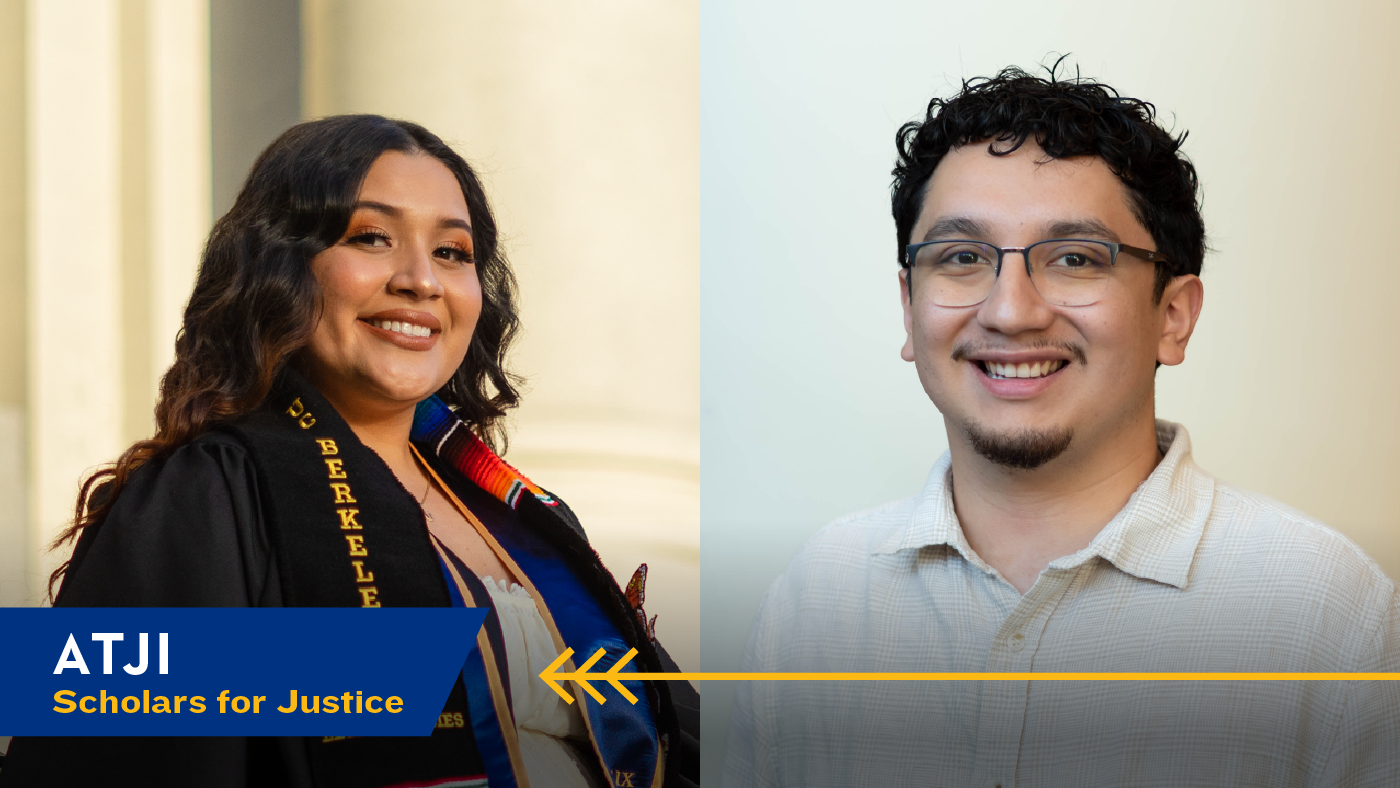
While this year’s two Scholars for Justice were raised in vastly different environments — one in a dense urban setting, the other in a rural agricultural town — both grew up in immigrant families and saw the challenges faced by their communities.
Inspired by their own lived experiences, the scholars intend to take their law degrees back to their hometowns to increase legal access for underserved groups.
Each school year, the Access to Justice Institute provides full-tuition scholarships to two incoming JD students who demonstrate commitments to community service, academic excellence, and a future in public interest law.
Scholars for Justice must take the Pro Bono Pledge to complete at least 100 hours of pro bono work before graduation. Additionally, they must maintain at least a 3.0 GPA, seek out volunteer and leadership opportunities, and commit to working in the public interest area of law for at least one year within three years of graduation.
Emily Godinez witnessed the challenges created by an underfunded education system during her childhood in Oakland, California.
“People there are hardworking and very diverse, but it comes with stereotypes that seep into the education system,” she said. “I have seen literacy issues; youth aren’t given a safe space and are more exposed to violence instead of education.”
While studying at a high school that taught subjects through an activist lens, Godinez was inspired to embark on a social justice-focused legal career. As she obtained her bachelor’s degree in sociology and legal studies at the University of California, Berkeley, Godinez interned at an immigration nonprofit, helping immigrants to obtain legal status. She later worked at another immigration nonprofit that provided financial assistance to immigrants during COVID, since many were not eligible for the government stimuli.
“It was hard to see that legal status defined who was getting help and who wasn’t,” she said.
Following graduation, Godinez, who grew up in an immigrant family, continued to work in immigration as a legal assistant and paralegal at a private firm and a nonprofit, respectively. She then returned to her alma mater high school as an academic mentor and substitute teacher, giving students support and advising upperclassmen who were deciding on their future paths. As a quasi-in-class tutor, Godinez would facilitate small-group teaching opportunities, focusing especially on students with certain needs. Godinez saw her past self in the students she mentored.
“I was guiding students to dream beyond what has been given to them,” she said. “I empathize with students who don’t know what the future will look like, who want to overcome the barriers in their community and come back to pay it forward. How can I better build myself to come back and re-invest what I know?”
While she does not see herself taking on a teaching career, her passion for the importance of education plays a role in the kind of lawyer that she wants to become.
“I don’t want to just advise people. I want to empower them, to educate them so they can use that knowledge and pay it forward,” she said. “I want to make sure the client has the power to know what is going on in their case and be confident, to give them peace of mind.”
When Godinez learned about Seattle U Law at a law school fair, she was instantly drawn to the school’s commitment to social justice and diversity. She is excited to possibly join the Post-Conviction Appellate Alliance and take part in criminal defense work, perhaps through the Defender Clinic. She hopes to one day return to Oakland and help members of the immigrant community. While the large city may not fit the strict definition of a ‘legal desert’ — an area lacking legal resources — she noted that many people may not know how to take advantage of those resources.
“I didn’t seek a law degree for the fame, I genuinely want to use it as a tool,” she said. “How can you become a member of a community that serves justice for everyone, not just corporations and money?”
Favian Mares grew up in the Yakima Valley, going with his immigrant parents to work the fields from a young age. With the help of college access programs such as Gear Up Achievers, he was able to attend the University of Washington, where he majored in education, communities, and organization, and minored in nutritional sciences. While in college, he volunteered with local organizations providing legal and educational services to immigrants, such as La Casa Hogar, El Centro de la Raza, and Legal Counsel for Youth and Children (LCYC).
“I got hooked into wanting to pursue a career that gave me the tools for systemic justice,” Mares said. “I want to provide more resources to my community to create more advocates, to make this weird language of law accessible.”
During his last year of college, Mares and a friend started a nonprofit called FEEDBACK (Fostering Educational Excitement Designed for Bold and Academically Curious Kids), which provides students in the Yakima Valley’s Toppenish School District with STEM learning opportunities and mentorship with college students. In three years, the program expanded from reaching six students to more than 50. Many of the students are from migrant backgrounds, and most will be the first in their families to graduate high school.
“These students aren’t lacking anything, they just need to be given an opportunity,” Mares said. “I want to shine a light on them so they can see, and the world can see, what they’re capable of.”
After graduation, Mares balanced Feedback with other college access positions, including, in what he called a “full-circle moment,” as a student success specialist for Gear Up Achievers, the very program that helped him.
“I was able to become one of the people who helped me get into college,” he said.
Mares sought out Seattle U Law because many of the people he had volunteered with at LCYC, El Centro de la Raza, and La Casa Hogar were alums. He appreciates the way the school “walks the walk” when it comes to the public interest and social justice focus.
“Since the beginning, I felt like Seattle U Law had my back, even before I was a student here,” he said. “They made it feel like home. The community welcomed my family with open arms at Spring Visit Day, in a space that no generation of my family has ever stepped in.”
During his three years of law school, Mares hopes to get involved in Moot Court, the Immigrant Justice Clinic, the Public Interest Law Foundation (PILF), the Latinx Law Student Association (LLSA), and the Health Law Society. Once he has his degree, he plans to return to his hometown and bring legal resources to the Yakima Valley, considered to be a legal desert.
“As a first-gen, low-income, agricultural person who relied on federal government services, there is a way the world perceives us as lacking a lot, needing the help,” Mares said. “Whether I lack a certain need or resource, at the end of the day, what I have more of is resilience, adaptability, determination, and grit. This is something life taught me as a way of existing.”