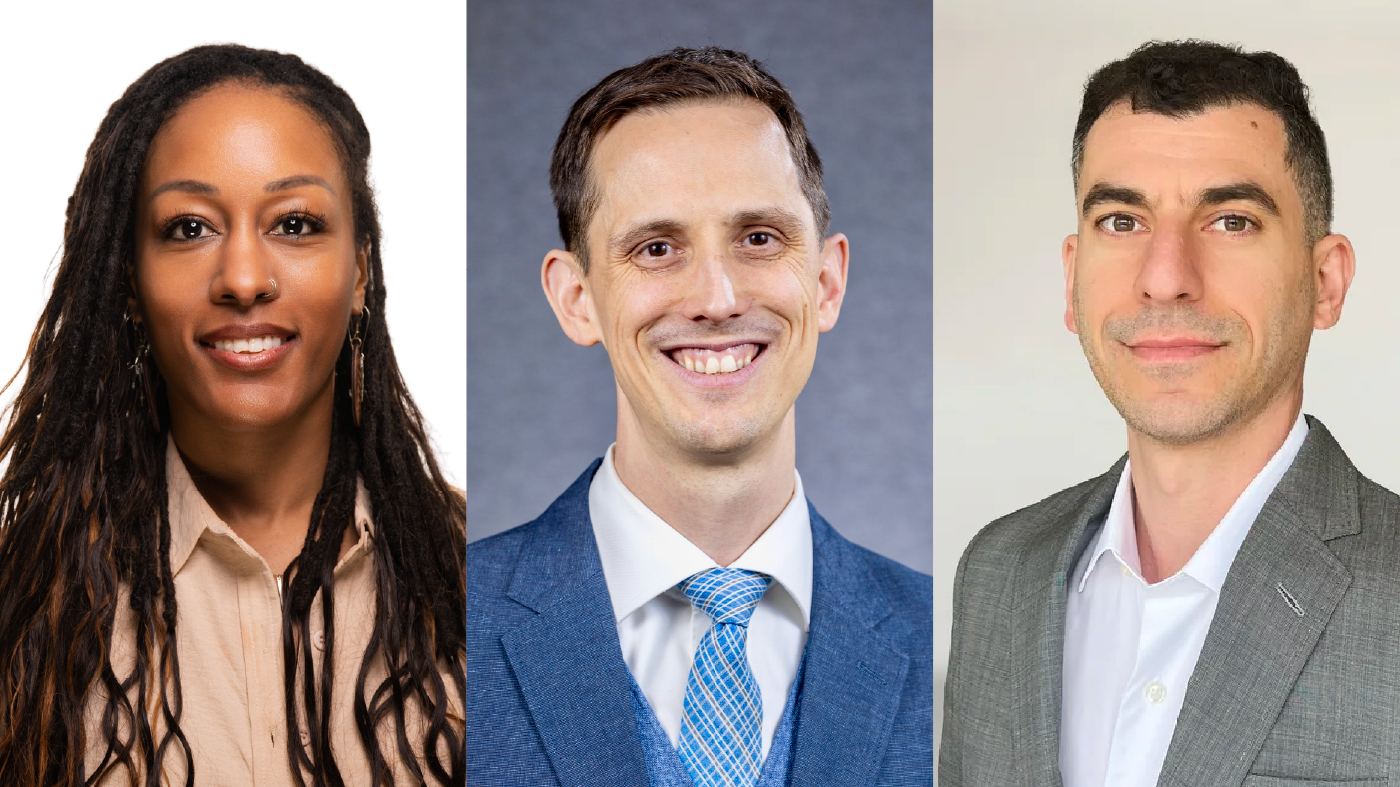
Flex JD Program students at Seattle University School of Law are a special bunch. Not only do they manage the high-demand studying, homework, and class attendance of law school, but many also have full-time jobs, care for families, and travel from out of state for hybrid weekends. Through evening classes and five in-person weekends per year, Flex JD students are able to earn a law degree in just three to three-and-a-half years. Here, we introduce you to three Flex JD students who are entering their 3L year:
Hannah Mosley
After 13 years as a social worker in her home state of Arizona, Hannah Mosley grew frustrated with the roadblocks she was finding in her ability to advocate for single mothers in transitional housing, many of whom are women of color.
“I felt very limited in what I could do as far as my role. I was mad about how the court was handling certain situations with single parents,” she explained. “The court system is a little old-fashioned when it comes to how they handle child safety. Finding legal representation that doesn’t dismiss you or is more knowledgeable can be hard to come by.”
Mosley looked across the country for a JD program that would allow her to continue working full-time and caring for her two children, settling on Seattle U Law because of the school’s social justice advocacy and because she has relatives in the area.
Despite having to fly in from Arizona, Mosley has been closely connected with campus life. She is a senior editor for the Seattle Journal for Social Justice and has competed with Moot Court and Dispute Resolution Board (DRB), placing first in a DRB competition last year and going all the way to nationals.
“Even though I’m out of state, because my classmates are all over, we find ways to stay involved and connected,” she said. “The school has been really inclusive.”
Having interned with the Washington Community Plan, Mosley plans to go into health care policy and advocacy with Arizona’s state Medicaid plan, the Arizona Health Care Cost Containment System (AHCCCS). Her dream is to create a one-stop-shop in Arizona for single moms in transitional housing.
“I have a personal goal with transitional housing to have a campus-type community – with legal options, therapy on-site, child care, educational resources, etc.,” she said. “There are only a few nationwide. It’s an amazing program that can accommodate so much.”
Con Nagy
Next time you take a flight out of Seattle-Tacoma International Airport, Con Nagy might be the one flying you. A commercial airline pilot with more than two decades of experience, he had looked into law school at the beginning of the pandemic, but was not able to find a program that would fit with his demanding flight schedule. It was not until he was seated as a passenger next to Dean Anthony E. Varona on a flight that he learned about the Flex JD Program and applied. Nagy is able to arrange his flights – which see him traveling to hubs across the country - for mornings or days that he does not have class so as not to interfere with evening courses.
Nagy said that studying law has been even more meaningful with a cohort of people working in a variety of professions.
“There’s a level of maturity amongst Flex students because a lot of us are parents, working professionals, we have a breadth of experience and backgrounds,” he said.
While the students only see each other in person a handful of times each school year, that has not stopped them from forming deep bonds with each other.
“As a class, you become very close with your peers,” Nagy said. “Even though you aren’t in law school continually, these are friendships you develop, you pick up where you left off the last time seeing them in person, you have close friends you study with. These will be friends for a lifetime.”
After graduating, Nagy plans to go into aviation law, specifically lawsuits over mishaps, such as plane crashes. Nagy explained that in these suits, aviation experts are brought in at considerable expense.
“I bring experience to the field that [other aviation lawyers] don’t have, especially on the plaintiff side where you don’t have access to the chief of testing, the engineers who designed it,” he said. “That kind of experience can be valuable because it costs money and time to bring on those experts.”
Nick Sutherland
Originally from Wisconsin, Nick Sutherland spent the first several years of his career as a sports journalist. When he moved to Seattle a decade ago, he realized that his writing skills would translate well to a legal career.
“What separates a good attorney from a great attorney is the ability to connect with your clients, to make them feel seen and heard,” Sutherland said. “From a reporter’s standpoint, it’s the same – you want the person you’re talking to to open up and trust you.”
Sutherland has spent the last several years as a paralegal at an estate law firm on King County’s Eastside, but he decided to study law to expand the opportunities available to him.
“I wanted to take the ceiling off my career,” Sutherland said. “As a paralegal, I can never become a partner. I’m a leader, I have big dreams and aspirations, I don’t want to be someone working behind the scenes.”
At Seattle U Law, Sutherland has embraced not only being a student again, but also being on the staff of a publication once more as a member of the Seattle University Law Review. He loves being in a program with students who work in a variety of fields and roles, from a health care CEO to a chief of police.
After graduating a semester early this coming May, he plans to take the bar in Washington, Wisconsin, and Nevada and hopes to continue working at his current firm. Sutherland would also like to return to Seattle U Law as an adjunct professor one day to “pay it forward.”
“The Flex Program is the gateway to opportunity,” Sutherland said. The idea of leaving my job, taking out loans, and going to law school could not be more unappealing. I could never have done that. There’s something to be said about the flexibility, it’s incredible.”