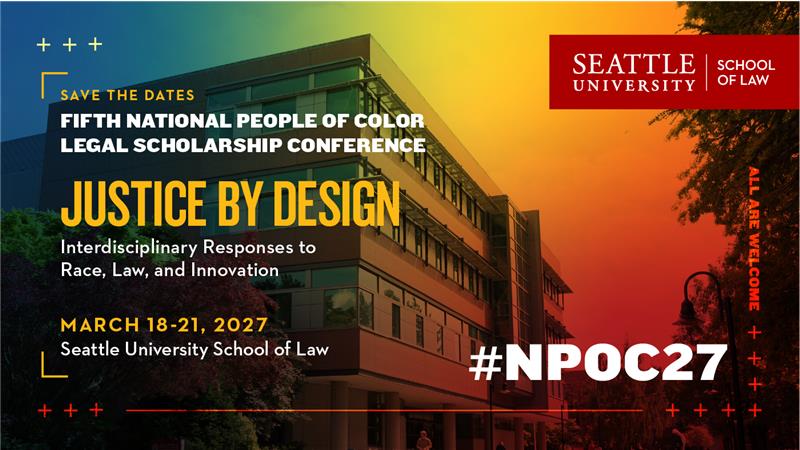
Seattle University School of Law has been selected to host a prestigious national conference focused on legal and policy matters affecting communities of color that takes place just once every eight to ten years.
The Fifth National People of Color Legal Scholarship Conference (NPOC27) will be held fewer than two years from now, in March of 2027, and will feature distinguished speakers, plenary sessions, works-in-progress workshops, and informal incubator sessions to discuss research, writing, and pedagogy.
Jeffrey Omari, who joined Seattle U Law’s faculty this month, will co-chair the conference with Access to Justice Institute Director Lily Su.
“It serves as a form of unity for scholars of color and our allies in the legal academy,” Omari said of the event, though he noted that the conference will be open to all legal scholars, regardless of race or ethnicity.
“As we look ahead to NPOC 2027, we’re excited to spotlight impactful research that supports the growing population of first-generation law students,” Su said.
The previous conference took place in 2019 at American University Washington College of Law in Washington, D.C., drawing 600 participants from around the nation. That conference was chaired by Seattle U Law Dean Anthony E. Varona, then vice dean at American’s law school. Given this experience, Varona spearheaded the effort to bring the conference to Seattle.
“Seattle U Law is proud to host this conference,” Varona said. “Throughout its history, our law school has been at the forefront of using the law to fight for access to justice and civil rights for marginalized communities. We look forward to being in community with legal scholars from around the country who share these values.”
“Because of the climate we’re in, where so many scholars who will be attending come from backgrounds or groups that are being attacked by our government, by the institutions we look to for support, we don’t necessarily feel that support in this moment,” Omari said. “I think it is a great opportunity for solidarity and community among scholars of color and all of those allies and comrades who stand together with us, to build our networks, and even to organize.”
Seattle U Law will form a host committee composed of faculty and staff that will collaborate closely with the NPOC National Steering Council, which has not yet been convened.
Omari said that so far, numerous prospective attendees around the country have expressed their enthusiasm.
“It's going to be amazing to have a conference of this scale at Seattle University,” Omari said. “There seems to be a lot of excitement and energy surrounding the conference, even though it is two years out. I’m looking forward to being amongst colleagues and building this type of community.”
NPOC involves the participation of the six regional People of Color Legal Scholarship Conferences (Mid-Atlantic, Midwestern, Northeast, Southeast, Southwest, and Western), as well as various national POC and/or progressive legal scholarship organizations, including the Society of American Law Teachers (SALT), LatCrit, the Critical Legal Collective, the Conference of Asian Pacific American Law Faculty (CAPALF), ClassCrits, eCRT, and other prominent groups.