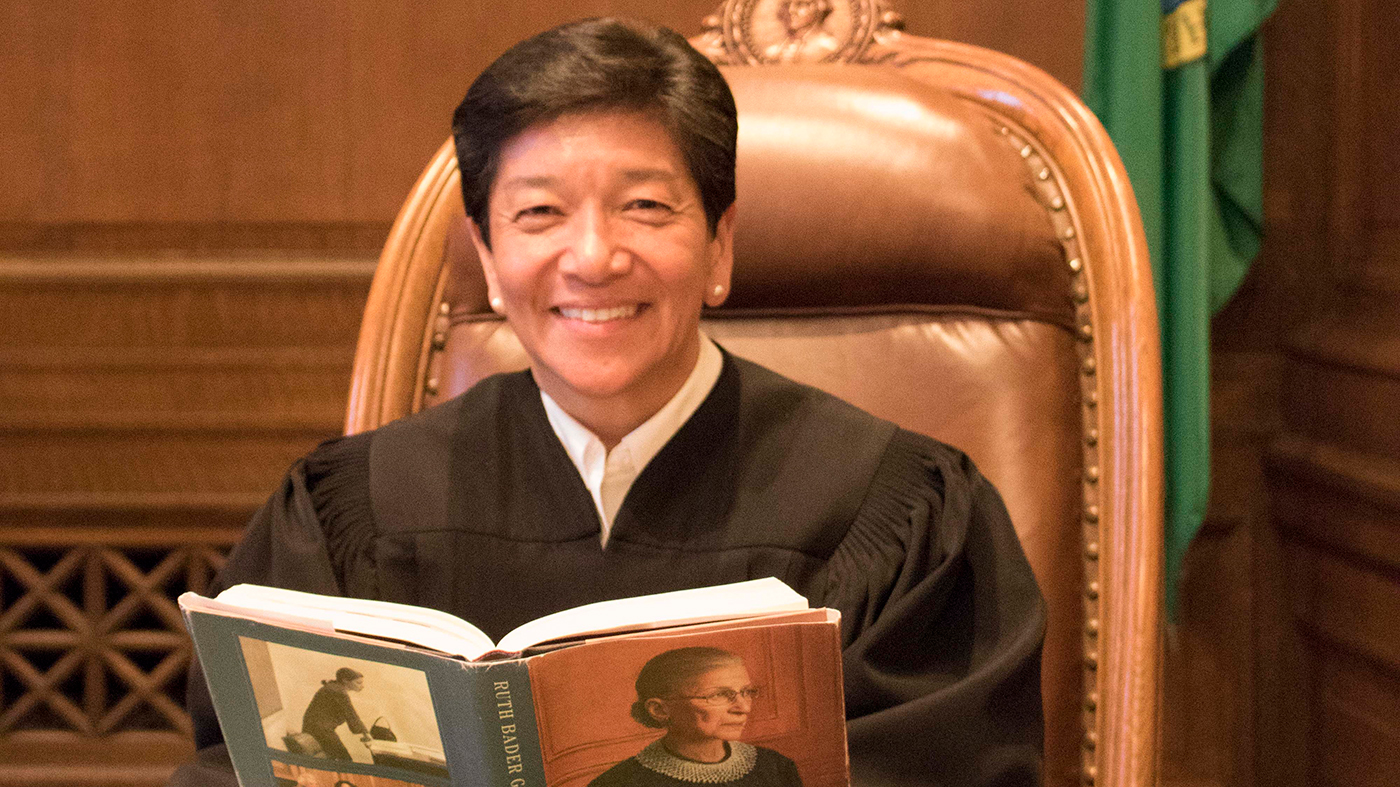
May Commencement’s keynote speech will be given by a retired Washington Supreme Court justice who has spent nearly two decades as a Seattle University School of Law Distinguished Jurist in Residence — Justice Mary Yu.
“It’s a privilege and an honor to be Commencement speaker,” said Yu, who retired from the court at the end of last year after more than a decade on the state’s highest bench.
“Justice Yu was our top and obvious choice for Commencement speaker this year,” said Dean Anthony E. Varona. “Her career has been nothing short of the vivification of our mission as a Jesuit, Catholic law school. She has been a mentor, teacher, and guide to so many of our students, and a quintessential leader serving justice.”
While Yu has not yet finalized what she is going to say, she plans to use her speech to inspire confidence in students to be themselves and stay proud of their diversity.
“I want to assure these students that there is a place in the world for them, and we all need to step out and be proud,” she said. “You’ve got to have these young people believe that that opportunity exists for them, too.”
Yu knows what it is like to feel out of place in the legal world. She grew up in a working-class neighborhood in Chicago’s South Side, the daughter of a Mexican mother and Chinese father. Her mother worked in fields, her father in a factory, and Yu grew up sleeping in the living room because there were not enough rooms for all of the children. She and her siblings found a sense of belonging and community in their Catholic school education. In fact, it was a high school teacher who first encouraged Yu, who had no college-educated relatives or family friends, to consider higher education for herself.
After graduating, Yu spent a decade at the Archdiocese of Chicago doing community organizing rooted in social justice. She looks back on these years as the proudest accomplishment of her life next to serving as a judge.
“Working at the Catholic Church for 10 years, doing that social justice work, was a privilege and taught me so much about the world and about people, about forgiveness,” Yu said. “Those 10 years were really foundational for me in terms of being a lawyer.”
Yu and her colleagues worked on issues that she said “are still relevant today,” such as housing, access to health care, access to the right to organize, and the wage gap between the rich and the poor. In one example, white homeowners refused to sell their properties to Black buyers. Yu realized that only with a law degree could she enact the change she wanted to see.
“I needed a new set of tools that would help me advance social justice. Law was the avenue to do that,” she said. “Absent the law, you really are subject to trying to persuade people to do the right thing. The law is the only thing that makes people do the right thing regardless of what they personally think.”
Following law school at the University of Notre Dame, she was hired by the King County Prosecutor’s Office, later becoming a King County Superior Court judge. After 14 years on the county’s bench, she was appointed to the Washington Supreme Court, the first woman of color and LGBTQ+ justice in state history.
“I was convinced that if you don’t apply, you won’t get the opportunity,” she said. “There weren’t many women of color judges at the time, so I had to at least apply.”
In her 11 years on the Supreme Court, Yu’s proudest moment is a decision involving a Seattle U Law alumna, Rep. Tarra Simmons ’17 (D-Bremerton), whom the Washington State Bar’s Character and Fitness Board had recommended be forbidden from taking the bar exam because of her criminal background.
“It was the most significant case in terms of changing the landscape,” Yu said. “People deserve a second chance, your past should not control your future.”
The Washington Supreme Court disagreed with the board’s decision and granted Simmons’ application, thereby establishing that legal barriers would be removed for future lawyers with a challenging past.
“We affirm this court's long history of recognizing that one's past does not dictate one's future,” Yu wrote in the opinion.
Yu has been a member of the Seattle U Law faculty since 2007, when Dean Emerita Kellye Testy invited Yu to teach.
“Seattle U Law’s religious, Jesuit mission drew me,” Yu said, pointing to values such as “the dignity of each person.”
“It resonated with my prior work in terms of trying to build a legal community that believes in social justice, that becomes skilled in the ability to analyze and see,” she said. “I wanted to build a cadre of competent lawyers, and the only way to do that is to roll up your sleeves and help people. I have to find ways to create paths for others to succeed.”
She feels especially close to the Class of 2026 because she spoke during their orientation. Many of the graduates were externs in Yu’s chambers or were otherwise mentored by her in different ways.
“I watched them journey over the last three to four years. They’re a special class to me,” she said. “What I want to do in my remarks is take the opportunity to affirm their decision to come here, to hang in there, and offer some words of encouragement to where they’re going. I really believe in them and am proud of them.”