- Foundations of Tribal Sovereignty and Environmental Justice
- Tribal Leadership
- About the Northwest Center for Indigenous Law
A recent workshop hosted by Seattle University School of Law’s Northwest Center for Indigenous Law (NCIL) drew a record number of attendees.
“Tribal Sovereignty Action | Tribal Authority, Free, Prior, and Informed Consent, & Environmental Justice,” hosted in partnership with Washington Conservation Action on Oct. 16, brought nearly 350 people together in person at the law school and on Zoom to discuss the issues most important to tribes around the state.
Professor Nazune Menka, faculty director of NCIL, called the large group of faculty, students, state government employees, and other legal community members who attended “one of the most attentive audiences [she has] seen in recent years.”
"We were honored to be able to partner with Washington Conservation Action to provide foundational knowledge on tribal sovereignty, and to educate our communities on the need for governments to develop lasting relationships and dialogue with tribal nations on matters that impact tribal ancestral homelands,” she said.
“The overwhelming interest in the event, evidenced by both high registration numbers and meaningful audience engagement, speaks to the demand for greater understanding of tribal nation-state relations among state employees, legal practitioners, and students alike,” said NCIL Director Brooke Pinkham. “This response not only affirms the significance of NCIL's work but also highlights an important opportunity for Seattle U Law to incorporate this subject matter in a more intentional and holistic way.”
Foundations of Tribal Sovereignty and Environmental Justice
Menka led the first panel, “Foundations of Tribal Sovereignty & the United Nations Declaration on the Rights of Indigenous Peoples (UNDRIP)’s Free, Prior, & Informed Consent.” She also co-led the second panel with Professor Monte Mills of the University of Washington School of Law’s Native American Law Center, “Toward Shared Governance: Tribal Sovereignty & Environmental Justice.” Both panels educated attendees about the legal and constitutional history of tribal sovereignty.
“I compared the best practices from collective Indigenous rights in the UNDRIP, and the principles of free, prior, and informed consent (FPIC) in UNDRIP, with tribal consultation and environmental justice,” Menka explained. “This comparison allowed attendees to think deeply about how tribal consultation falls short of recognizing that FPIC is a process built on continued relationship-building with tribal nations.”
Tribal Leadership
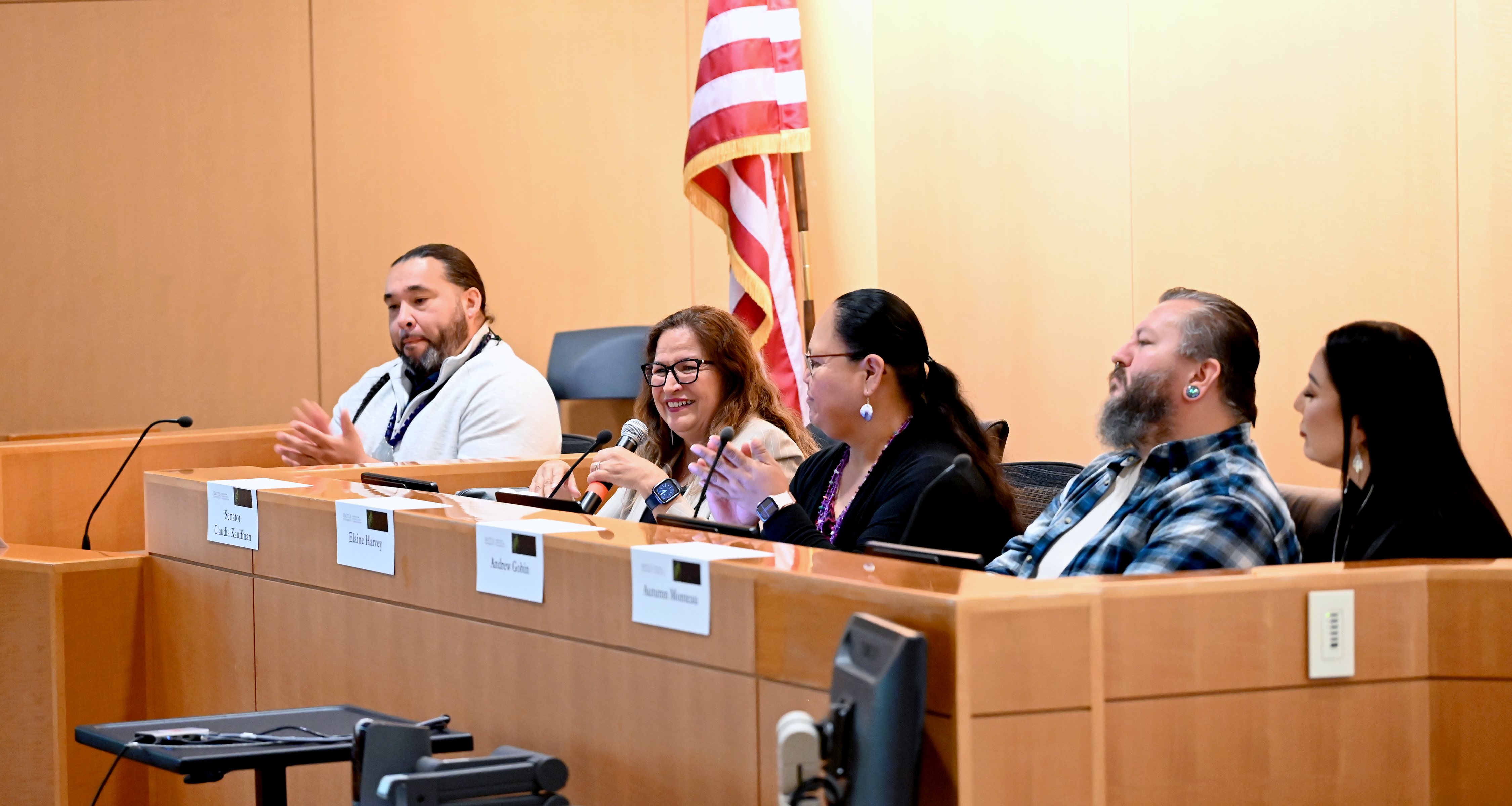
The third and final panel consisted of tribal leaders from around the state: 47th Legislative District Sen. Claudia Kauffman (D-Kent); Association of Washington Tribes Executive Director Patrick DePoe; Autumn Monteau, of counsel at Crawford, Skikos and Joseph LLP; Columbia River Inter-Tribal Fish Commission Watershed Department Manager Elaine Harvey; and Tulalip Tribes Treaty Rights & Government Affairs Director Andrew Gobin.
“This panel was highly significant because it brought together Native leaders doing work in all areas – from legislative policy work, to litigation, and grassroots community activism,” Pinkham said. “I think our audience appreciated the diverse perspectives from these leaders.”
Panelists discussed a variety of current issues, from the building of energy projects and data centers on tribal lands to the lawsuits brought by tribes against pharmaceutical companies over the opioid crisis.
“These serious issues are impacting our tribal livelihood, our tribal sovereignty, and it’s a big concern,” Harvey said. “Salmon is our life, the Columbia River is our life, our root-gathering ground is our life. And they’re all under threat.”
“At the end of the day, these are our lands, since forever,” Gobin said. “Our blood comes from these lands. Our culture comes from these lands. We can’t pick that up and move it somewhere. When you do that damage, you do it to us.”
Kauffman, who is a member of the Nez Perce Tribe, talked about the importance of tribes having a seat at the table where laws are being made. As the Senate Democratic Caucus’ tribal liaison, she keeps a log of every bill that affects tribes and facilitates meetings between tribal leaders and legislators during the session.
“I always say that tribal leaders should receive honorary doctorate degrees from all the public institutions because they have to know federal law, they have to know international law, they have to know state law, county law, city law,” Kauffman said. “They have to know all of their own tribal codes. They need to know the tribal ceremonies, practices. Everything that we do, the knowledge that they keep, is amazing to me.”
You can watch a video of the entire workshop online.
About the Northwest Center for Indigenous Law
The NCIL advances education, scholarship, and community-engaged legal work in service of tribal sovereignty and Indigenous communities. Through its certificate, experiential opportunities, the American Indian Law Journal, and student programs, the NCIL expands pathways to legal education and prepares lawyers to work in federal Indian law, tribal legal systems, and other areas of law affecting Indigenous peoples.