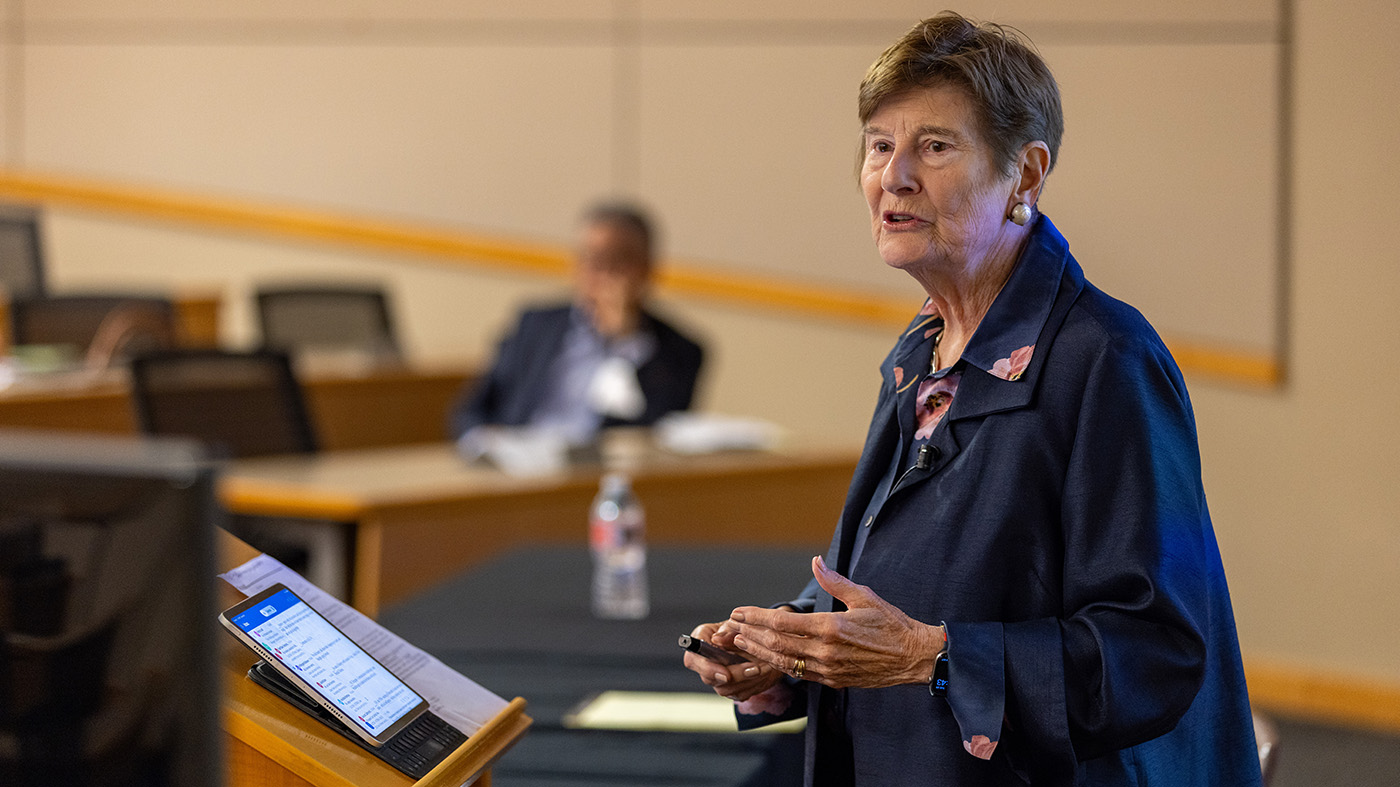
Senior Judge Margaret McKeown of the U.S. Court of Appeals for the Ninth Circuit began her keynote speech at the Seattle University School of Law Technology, Innovation Law, and Ethics (TILE) Institute’s 2026 Annual Symposium with a quote comparing rapidly evolving technology with magic.
“Any sufficiently advanced technology is indistinguishable from magic,” states the quote from British science fiction writer Arthur C. Clarke.
“Technology develops at breakneck speed, and we often look for solutions before we understand the technology,” observed McKeown, a Seattle U Law distinguished jurist in residence.
McKeown’s talk, "The Baby, the Bathwater, and the Algorithm: The Courts and AI," explored how courts are tackling disruptive technologies and new challenges in a world that is increasingly becoming more digital. The current discourse around artificial intelligence, McKeown said, ranges from calling it a wonderful tool that will revolutionize workflows to an apocalyptic danger that threatens the very existence of humanity.
“There is no through-line, there is no unanimity, and I really think there is almost an open tablet to see what we're going to do,” she said.
While generative AI models have burst on the scene in just the past few years, McKeown noted that conversations expressing fear over the advent of artificial intelligence go all the way back to the 1950s - the era when robots were shown in pop culture helping futuristic societies like that of “The Jetsons” with daily tasks.
This does not mean, however, that regulation of AI has a similarly long history. Actual court cases involving the role of AI are far more recent, with the U.S. Supreme Court only referencing it for the first time in 2024.
Now, McKeown said, there are 102 active cases against AI in the courts, ranging from topics such as copyright violation to privacy to consumer protection to defamation. Job-seekers have sued for employment discrimination, claiming employers are ignoring perfectly qualified candidates by using AI to filter through applications for certain buzzwords. Heartbreakingly, families of teens who committed suicide are suing tech companies after chatbots seemingly encouraged the teens to carry out their plan, rather than linking to information about suicide hotlines and mental health services.
In one case, a chatbot told a young person that “his childhood cat would be waiting for him on the other side,” McKeown said.
She compared these lawsuits to those filed by states against Big Tobacco in the 1990s. Parents suing AI seek regulations such as time limits for minors who are currently spending many hours a day on AI chats, the blocking of AI sites during certain hours of the day and night, and chat auditors.
AI plays a role not just as the subject of court cases, but as a tool that has been used by lawyers and judges alike – for better and for worse. AI has been known to hallucinate cases cited by attorneys, or to reference real cases with made-up facts, quotes, and citations. Penalties for lawyers and judges using AI have ranged from fines of up to $100,000 to mandatory ethics courses and even bar suspension.
Conversely, AI seems to have empowered some people to become their own advocates. McKeown noted that the number of pro se litigants filing cases in 2025 was nearly double that of prior years, which she attributes in part to people using AI instead of hiring a lawyer.
“AI has provided an avenue for transparency and also for access to the courts, but it's also not without complications,” she said. Noting that lawyers are costly and the court process can be slow, she posed the question, “How can AI advance access to justice?”
Ultimately, McKeown said, AI has the power for good, but it must be used carefully, thoughtfully, and with the proper parameters mandated by law to ensure it does not get out of hand.
“We need to recognize that AI is just a tool - it is not a replacement for human judgement. It is a double-edged sword, so we shouldn’t be embracing AI without making an independent and sophisticated judgement,” McKeown said. “We're not throwing the baby out with the bathwater here. Our challenge is to enhance, not to replace human thought. But we have to do so ethically and responsibly, and with a certain amount of continuity.”
You can view a video of McKeown’s speech and one of the entire symposium online, as well as a photo gallery.