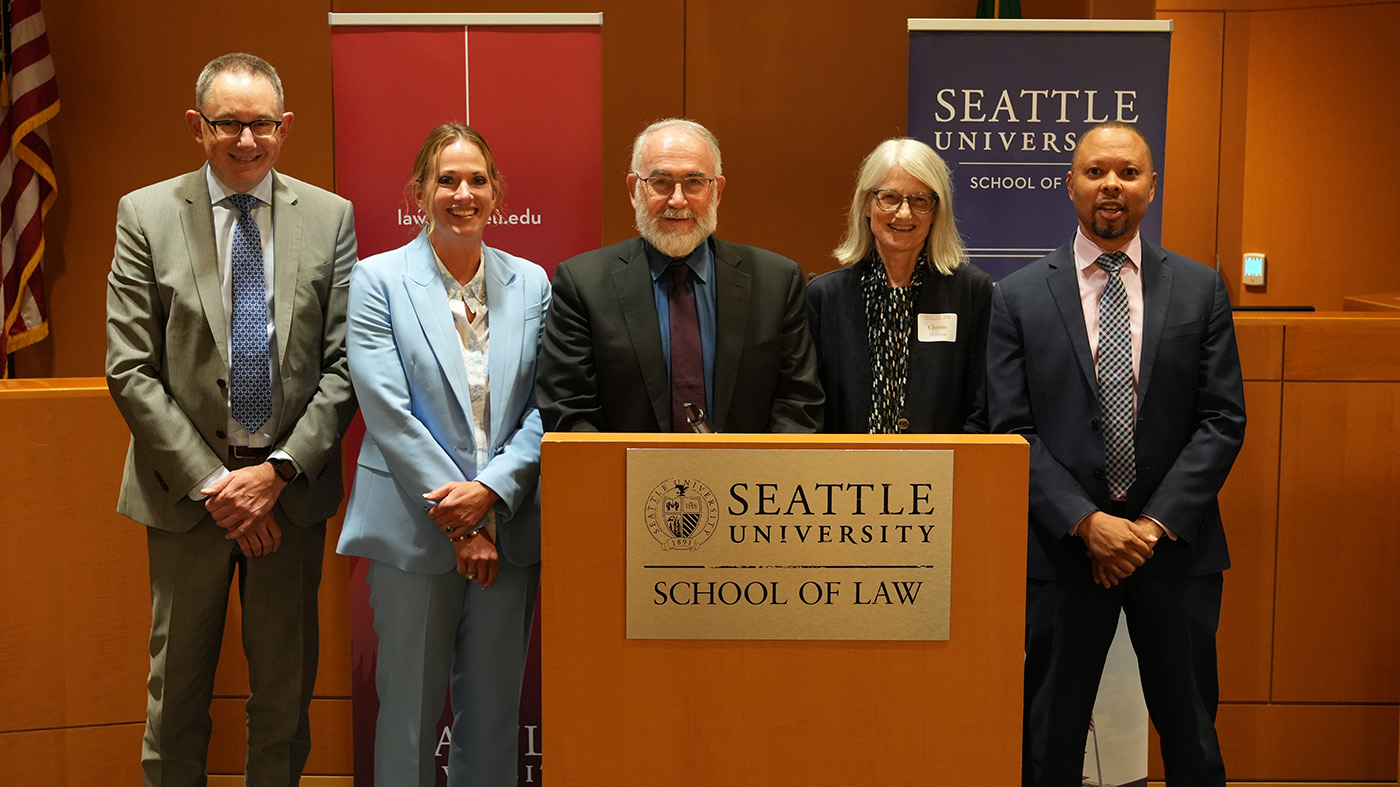
At least three themes emerged from the Defender Initiative’s 15th Conference on Public Defense at Seattle University School of Law on June 26, 2026. The Washington Supreme Court has recognized a crisis in public defense resulting from changes in practice and as deeper understanding of the adverse impact of excessive defender workloads. The court set new limits on defender workload. To meet those new limits and to bring equity to disparate allocations of resources across the state, significant increases in state funding are needed for local governments to meet their constitutional obligation to provide public defense services. Second, diversion programs can take cases out of the legal system, reducing the defender workload, while helping people avoid recidivism and saving money in the legal and health care systems. Third, more public education on the role of defenders is needed.
Some of the legislators present at the conference noted a public perception that defenders just try to get “bad guys set free to wreak havoc on the rest of us” and emphasized the need to provide legislators more detailed information to understand how important well-funded public defense is to public safety. One recommendation was to provide legislators tours of defender offices and courts and jails so that they could understand more fully the role of defenders and the barriers they face in providing effective representation.
The three legislators present, Sen. Jamie Pedersen (D-Seattle), Rep. Strom Peterson (D-Edmonds), and Rep. April Berg (D-Mill Creek), expressed strong support for defenders and for expanding state funding. Representative Berg said, “Public defense is American as apple pie.” She recalled that John Adams had defended a British soldier in the Revolutionary War. Every person, she said, deserves a good defense. She said that the right to be defended is in the founding of the country and that it makes us a great democracy.
Two of the legislators noted the number of aging prisoners with long sentences who do not need to be incarcerated. But one noted that “criminal justice reform is the third rail” for many in the legislature. The legislators recommended developing coalitions with people who may not usually agree on criminal justice issues. One noted that the legislature cut funding for victim support services. Another recommendation was to help legislators understand that having different approaches can be a better way to spend money.
Successful Whatcom County Diversion Program
The presentation about the implementation of the LEAD diversion program in Whatcom County showed dramatic cost savings by helping people get housing and mental health and substance abuse treatment. LEAD, Law Enforcement Assisted Diversion or Let Everyone Advance with Dignity, aims to connect people to the resources they need. The resulting savings are not only in the legal system. In Whatcom County, there was a 92% reduction in the use of emergency medical services for LEAD participants from before and after they had graduated the program. Over a three-year period, there was an annual average 86% reduction in potential jail and EMS costs for the participants, including 92% reduction in jail bed days, with an estimated total cost avoidance of $7.5 million. This was with an annual investment in LEAD of about $1 million for a team of eight persons.
For 15 LEAD participants, they had 345 police contacts in the 24 months before they entered the program, and 59 in the 24 months after their enrollment in the program.
There has been some resistance by police and prosecutors to participate in LEAD. But in a video, former King County Prosecutor Dan Satterberg said that some of his lawyers, having been on a LEAD rotation, “had trouble going back to being traditional prosecutors because they saw the humanity” in the LEAD program.
Chad Winfrey, a former Department of Corrections Specialist who now works with the LEAD Support Bureau, explained how he went from skepticism to strong support for LEAD. He described the program as being creative and compassionate and having a positive public safety impact, helping businesses. People who normally are “siloed” collaborate to keep people from falling through the cracks.
But funding for LEAD and its associated Recovery Navigator Program statewide was cut in the past two legislative sessions.
State Provides Small Percentage of Needed Funding
The Washington State Office of Public Defense reported that in 2025, counties spent about $240 million on public defense. The state contributed only $6 million to the counties. While the state amount increased to $11.9 million for FY 2026, the gap remains vast. The cities spend an estimated $54 million per year for their municipal court defense.[1]
The current funding levels are woefully inadequate. Just to keep pace with the required reductions in attorney caseload will require increased funds to hire more attorneys. But many counties and cities do not have adequate support staff for their current caseload. The need for defender social workers has been increasingly recognized nationally,[2] but 59% of the counties report no use of social workers. Six county offices report having no investigators on staff; Yakima has one for its 21 attorney positions. 13% of the offices report spending no funds on expert witnesses in superior court.
The lack of professional support staff conflicts with Washington State Bar Association Standards for Indigent Defense Services[3] that set ratios for staff:
"In public defense agencies, by July 3, 2028, a minimum of one full-time mitigation specialist or social worker shall be provided for every three full-time attorneys. Public defense agencies shall make meaningful progress towards this ratio prior to July 3, 2028.
…
In public defense agencies, by July 3, 2028, a minimum of one fulltime investigator shall be employed for every three fulltime trial court level (adult and/or juvenile) attorneys. Public defense agencies shall make meaningful progress towards this ratio prior to July 3, 2028."
Compensation for Defenders Varies Dramatically
In some jurisdictions, compensation for attorneys and staff is below what other public sector folks are paid. Recruiting and retaining staff is difficult as a result. In Spokane, entry level county prosecutors are paid about $5,000 per year more than defenders with the same experience. [4]
And some counties can pay dramatically more to their staff than others. For example, while the cost of living is higher in Spokane than in Yakima,[5] Yakima pays about $20,000-$30,000 more per year to attorneys than Spokane, and some Spokane defenders have left to go to Yakima. Yakima has advertised entry level defender attorney positions with a salary range of $102,000 - $110,408.[6] Spokane’s entry level defender attorney jobs have a salary range of $72,436.44 - $88,119.26.[7]
Three Lawsuits Raise Workload and Funding Issues
Three panelists at the conference discussed three different pending lawsuits. The ACLU of Washington has sued Yakima County for not providing lawyers to eligible accused persons for days or weeks after they are charged. The trial judge certified several questions to the Washington Supreme Court, which is considering whether to accept review. [8]
The Washington Association of Counties has sued the state and the King County Department of Public Defense has intervened in the case. The counties allege:
"The state does not provide sufficient funding for their indigent defense services to meet constitutional standards. Additionally, the counties allege that there are gross disparities among their abilities to raise funding for indigent defense, which adversely affects poorer counties. These systemic deficiencies, according to the counties, violate equal protection and the right to counsel in the state and federal constitutions." - Washington State Association of Counties. v. State, 34 Wn. App. 2d 879, 883, 572 P.3d 1225, 1228 (2025).
The Court of Appeals reversed the trial judge’s ruling that the counties did not have standing to assert that there was inadequate state funding for public defense and remanded the case for trial.
The third lawsuit was brought by the directors of the two Spokane County defender offices. [9] The directors had adopted the Washington State Bar Standards for Indigent Defense that called for reducing caseload limits as of July 2025. The county commissioners developed in December 2025 their own caseload limits that exceed the WSBA Standards and would require defenders to increase their caseloads. The Washington State Supreme Court issued a clarifying order November 6, 2025, that stated in part:
"The requirement that the reduced caseload standards be implemented 'as soon as reasonably possible' does not allow for any increase in caseloads above those currently in place, even in jurisdictions that are already ahead of the court’s implementation schedule. Similarly, failing to implement annual reductions is contrary to implementation 'as soon as reasonably possible.'” [10]
The county commissioners’ newly developed limits would violate the Supreme Court order forbidding increases above the caseload limits the defenders had in place in November.
Several conference participants suggested that the litigation might help to persuade legislators of the need for more state funding.
During the Defender Initiative Conference, several defender advocates held a press conference, calling for much greater state funding to address the inequities across the state. [11]
The reality is that while Washington has some of the best public defense in the country, the lack of adequate funding threatens the quality of that representation and results in major inequalities across the state.
In this month of the U.S. celebrating the country’s 250th anniversary, an Irish columnist, criticizing the Irish government’s decision to change payments to public defense counsel to one flat fee instead of fees per hearing, wrote, “We know from places like the USA that a poorer quality of representation for defendants leads to increased levels of crime, and definitely ends up with unjust results for those before courts.” [12]
Washington has models of how to do public defense effectively and how to implement effective diversion programs to divert cases from the criminal legal system. At the same time, there are counties where accused people wait days or weeks for a lawyer to be appointed. In too many jurisdictions, when people get a lawyer, the lawyer is inadequately paid, does not have adequate support staff, and is pressured to take more cases than the lawyer can ethically do. The Washington State Bar Association and the Washington State Supreme Court have taken major steps to improve the situation, but major increases in state funding are needed to help local governments provide the people and the resources needed to provide effective representation.
The Defender Initiative Conference addressed all these issues. The Legislature needs to act to meet the needs of local government and the people in their courts.
Robert Boruchowitz is a professor at Seattle U Law and director of the Defender Initiative. Faculty Voices is a new series that regularly features op-eds from members of the Seattle U Law faculty.
Footnotes
[1] See, “Enhance Indigent Defense”, available at https://wacities.org/docs/default-source/legislative/factsheetindigentdefense2026.pdf?sfvrsn=ae8a2c4f_2
[2] See, ABA Ten Principles of a Public Defense Delivery System (2023): “Public Defense Providers should have the assistance of investigators, social workers, mitigation specialists, experts, and other specialized professionals necessary to meet public defense needs.” Available at https://www.americanbar.org/content/dam/aba/administrative/legal_aid_indigent_defendants/ls-sclaid-ten-princ-pd-web.pdf.
[3] WSBA Standards for Indigent Defense Services (2024), available at https://www.wsba.org/docs/default-source/legal-community/committees/council-on-public-defense/wsba-indigent-defense-standards-as-approved-by-bog-2024.03.08.pdf?sfvrsn=3c831ff1_5.
[4] See job openings web page at https://spokanecounty.wd503.myworkdayjobs.com/en-US/Spokane/details/Prosecuting-Attorney-1_JR100017?q=defender, last checked July 9, 2026.
[5] See, 2026 Compare Cities Cost of Living: Spokane, WA vs Yakima, WA
https://www.bestplaces.net/compare-cities/spokane_wa/yakima_wa/costofliving
[6] Yakima County job openings web page at https://yakimacounty.wd5.myworkdayjobs.com/en-US/YakimaCountyWA/details/Attorney-I-II--Civil-_R2955, last checked July 11, 2026.
[7] Spokane County job openings page at https://spokanecounty.wd503.myworkdayjobs.com/en-US/Spokane/details/Attorney-1---Pub-Def_JR100012, last checked July 11, 2026.
[8] See, Statement of Grounds and Motion for Discretionary Review, at chrome-extension://efaidnbmnnnibpcajpcglclefindmkaj/https://law.seattleu.edu/media/school-of-law/documents/centers-and-institutes/korematsu-center/initiatives-and-projects/defender-initiative/2026-06-16---Cuevas-v.-Yakima-County---Statement-of-Grounds-and-Motion-for-Discretionary-Review---Final-w-App.pdf.
[9] See, “Public defenders sue Spokane County over work standards”, Spokesman Review, May 11, 2026, at https://www.spokesman.com/stories/2026/may/11/public-defenders-sue-spokane-county-over-work-stan/.
[10] Clarifying Order IN THE MATTER OF THE STANDARDS FOR INDIGENT DEFENSE IMPLEMENTATION, available at chrome-extension://efaidnbmnnnibpcajpcglclefindmkaj/https://www.courts.wa.gov/court_rule_related_orders/orders/25700-A-1671.pdf.
[11] See, “Public defenders warn of public safety crisis without more funding”, Seattle Times, June 29, 2026, available at https://www.seattletimes.com/seattle-news/public-defenders-warn-of-public-safety-crisis-without-more-funding/.
[12] Mick Clifford: “Does crime pay? Legal aid changes are unfair to solicitors and suspects alike”,Irish Examiner, July 4, 2026, https://www.irishexaminer.com/opinion/columnists/arid-41873364.html.