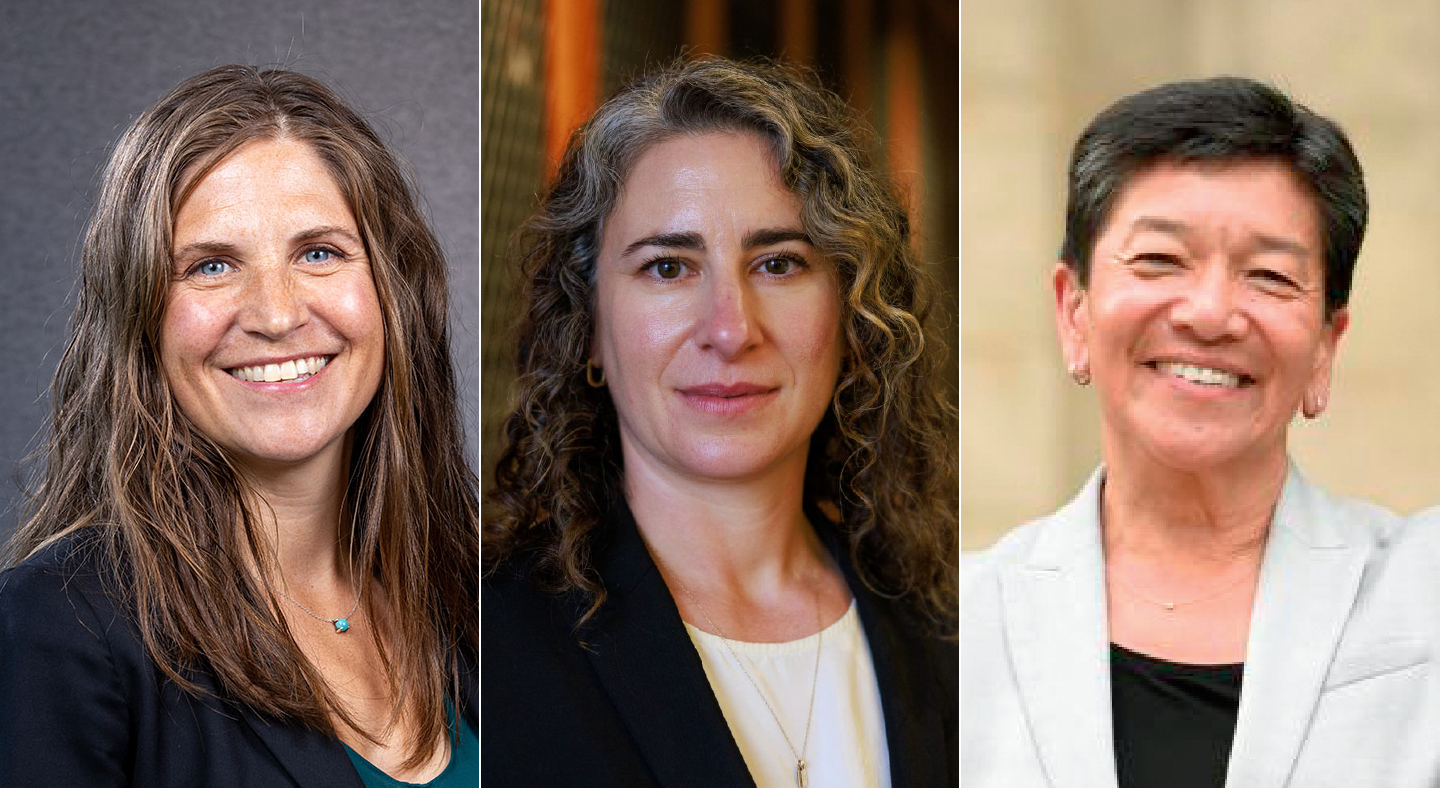
Seattle University School of Law announces the promotion of Melissa Lee to executive director and Jessica Levin '08 to senior director for the Center for Civil Rights and Critical Justice, effective immediately. Lee and Levin, who previously served as the center’s co-directors, will serve as the first to hold these newly created positions.
"I am thrilled to name Professor Lee as the new executive director, and Professor Levin as the new senior director" said Anthony E. Varona, dean of Seattle University School of Law. "Professors Lee and Levin have both spent many years championing equity and constitutional rights, both in the courtroom and the classroom. Their visionary leadership makes them the ideal leaders to advance our mission of training the next generation of civil rights attorneys.”
During their tenure at Seattle University School of Law, Lee and Levin have been key to establishing the Center for Civil Rights and Critical Justice (CCRCJ), where they have expanded student educational opportunities through growth of both the Civil Rights Clinic and the Calhoun Family Fellowship. Lee and Levin were also central to the success of CCRCJ’s predecessor, the Fred T. Korematsu Center for Law and Equality, where they served as staff attorneys and assistant directors for many years. In collaboration with their Civil Rights Clinic students and advocacy partners, they have contributed to state constitutional jurisprudence in the areas of juvenile sentencing, race-based prosecutorial misconduct, police seizure, capital punishment, and minimum wage protections.
Prior to joining the faculty, Lee served as managing attorney of the Institutions Project at Columbia Legal Services. Levin completed two appellate clerkships and practiced civil litigation at Gordon Tilden Thomas & Cordell.
"It is an absolute honor to step into this role at a time when civil rights protections face unprecedented challenges," said Lee. “I look forward to collaborating with Professor Levin, our brilliant students, faculty, and community partners to use legal advocacy as a tool for systemic change and racial justice.”
Additionally, retired Washington State Supreme Court Justice Mary Yu joins the CCRCJ as a distinguished jurist in residence. In this new role, she will be providing strategic advice on advocacy issues, serving as an ambassador for the center, and co-teaching courses relating to state constitutional law and civil rights. Yu’s depth of experience, commitment to addressing civil rights and liberties, and expertise in interpreting the Washington State Constitution will greatly enhance the center’s advocacy and bring significant benefits to the law school community.
"I am thrilled that Justice Yu has expanded her role and presence at our law school in this very meaningful way, and especially in close association with the center,” Varona said. “Her contributions to civil rights, constitutional law, and the rule of law itself are extraordinary, and I have no doubt that her work with the center will take it to new heights of effectiveness and achievement."
Yu joined the Washington State Supreme Court in May 2014, after more than 14 years as an accomplished trial court judge in King County Superior Court. Prior to becoming a judge, she served as deputy chief of staff to King County Prosecutor Norm Maleng and as a deputy in the Criminal and Civil Divisions.
After serving for more than 25 years on the bench, including 11 years as a justice of the Washington State Supreme Court, Yu retired at the end of 2025. As the first Asian, the first Latina, and the first member of the LGBTQ community to serve on the Washington State Supreme Court, Yu is known for her work to address structural inequality in Washington. She wrote groundbreaking opinions in many cases addressing systemic injustice, including a case focused on racial profiling in police encounters (State v. Sum) and another finding that a Seattle University law graduate and current state representative with a criminal record was eligible for admission to the bar after the Washington State Bar Association had denied her application, noting that “one’s past does not dictate one’s future” (In Re Application of Tarra Simmons). In considering where she wanted to dedicate her time in the coming years, the CCRCJ was a clear choice.
“I am delighted to have the opportunity to work with Melissa Lee and Jessica Levin. They are exceptional legal scholars whose thoughtful amicus briefs on complex social issues have made significant contributions to the development of our state common law,” Yu said. “I look forward to supporting their efforts to advance the use of our state constitution as a primary tool for addressing challenging and uniquely important questions of law. I am equally excited about the opportunity to work with law students who are eager to deepen their understanding of our state constitution and its application to civil rights.”
“With the addition of Justice Mary Yu as jurist in residence at the center, advancing civil rights protections under state constitutions will gain even more momentum - and we are honored to work alongside her,” said Levin.
About the Center for Civil Rights and Critical Justice
The Center for Civil Rights and Critical Justice works to achieve a legal system where both historical and present-day racism, oppression, and marginalization no longer control outcomes or otherwise contribute to inequality. The center educates future lawyers to be agents for social change and racial equality in all areas of the law, advocates for advancement of the law to achieve equal justice, and produces research to drive effective reform by revealing systems of oppression and exclusion.